Friday, July 10, 2009

"Joujouka via Johnny Cash" : Joujouka producer Frank Rynne interviewed by Paul Hawkins

JOUJOUKA (VIA JOHNNY CASH) Interview with Master Musicians of Joujouka producer and current manager Frank Rynne by Paul Hawkins


Ahmed Attar leader of Master Musicians of Joujouka dancing 1968 All rights Master Musicans of Jououka. Contact: joujouka@gmail.com


Paul Hawkins interviews Frank Rynne on the world's oldest Rock' n' Roll band : The Master Musicians of Joujouka

The Master Musicians of Joujouka were first promoted in Western literature by William Burroughs in the 1950s. Since they first attracted the attention of Burroughs' sidekick Brion Gysin in the early fifties, The Master Musicians of Joujouka have been feted and visited by a host of cultural luminaries including Paul Bowles, Brian Jones, Acid guru Timothy Leary, who wrote an essay on his trip in Jail Notes (1971), Ornette Coleman, The Rolling Stones, and latterly by producers Bill Laswell and Frank Rynne. The most recent celebrity to receive the musicians' hospitality in Joujouka (or Jajouka) was Smashing Pumpkins leader Billy Corgan who Rynne accompanied to the remote mountain top in 2006.

Rynne's Joujouka experiences are different from many westerners. Rynne, like Brion Gysin, who spent 23 years in Morocco so as to be close to the musicians, has kept up his contact and made dozens of visits to the village over the past fifteen years. Like Brion Gysin he was a friend of the Moroccan painter Mohamed Hamri who first brought his native village and their Master Sufi trance musicians to the notice of the Western avant garde. Rynne's knowledge of the village, the music, culture and the individual villagers is unparalleled.

I caught up with Frank Rynne to find out about his work with the Master Musicians of Joujouka, which is soon to enter its sixteenth year. Frank talks about recording three CDs, radio shows, films and soundtracks in Joujouka, as well as managing the Master Musicians of Joujouka.

*************************

Being a fan of William Burroughs, Frank, getting to visit the Master Musicians in their home village of Joujouka must have been amazing. The village is linked closely to the Tangier Beat Generation; tell me about your first time out there.

There had been a bit of journey to get to that point. I don't think Burroughs was on my mind when I eventually got there. Not at first in any case. It took a few weeks to absorb the reality and put it into the context of things that I had read. At my side through my first adventures in Joujouka was Mohamed Hamri who was himself the equal to anyone else considered to be part of the beat generation in his personality, talent and his ability to tell a story.

I know that you first met Hamri at the Here to Go Show in Dublin back in 1992...Tell me about that.

In 1992 I co-organised the Here to Go Show, an art show celebrating the work of William Burroughs and Brion Gysin. Being a musician I was particularly interested in the musical connection between the painters we exhibited: Burroughs, Gysin and Hamri the Painter of Morocco. That music was of course the Master Musicians of Joujouka who Brian Jones posthumously made famous by recording them and later, in 1971, The Rolling Stones released his album as the first release on Rolling Stones Records.

Their presence was powerful one at the Here To Go Show..........the Destroy All Rational Thought DVD captures the aura really well.........

Hamri rightly insisted that the Master Musicians of Joujouka were essential to any event promoting Brion Gysin so I worked on getting Joujouka to the show. Gysin's love of Joujouka trance music kept him in Morocco for 23 years. After the show I kept in touch with Hamri by phone and he kept insisting I come to Joujouka. It took a few years to get there but when I came I had a contract with Sub Rosa Records to do a CD and it took precedence over other concerns. The result of my first three months there was the Joujouka Black Eyes CD released in 1995. Recording it was an amazing experience.

So how did the recording sessions go?

Around 10 am every day, as I awoke after another all night session of music, I would hear the musicians' voices outside. The sound of Hamri's slippers in the kitchen was my call to duty. Hearing the kettle put in place and the sound of eggs sizzling in a metal plate, I would go out and greet the Mallims (Master Musicians) on the veranda.

Joujouka Black Eyes was recorded in organic moments. We'd eat, talk, then have some music, eat, move to the back of the house away from the sun, and have a little music. Day and night blended together. Time was marked by a Friday ritual; the older musicians were shaved by the younger ones before they went to the mosque. Occasionally Hamri would get restless and after 12 days we would return to Tangier for a weekend.

Which is where Hamri and Brion Gysin had their 1001 Night restaurant and where they insisted the Master Musicians played for the diners, who were often writers, artists and musicians associated with the Tangier Beats.........

Yes it was in Tangier that Hamri met Paul Bowles in 1950 and later Gysin and Burroughs. Tangiers was where the Beats gathered in Morocco in the 1950s and 1960s. It was an International Zone ruled by six powers who all vied for prominence. This was the Interzone of Burroughs' fiction and Gysin and Hamri were at the centre of that world. In Tangiers it was easier to connect with the Burroughs spirit. He drew on the city so much for his fiction and even though Dean's Bar is now covered in Real Madrid memorabilia it still retains something essentially seedy and Mugwumpish. Maybe it's the cockroaches.

Maybe! Burroughs championed their music, and by doing that, the whole culture and spirituality, didn't he?

Burroughs' reverence and respect for the Masters was without prejudice. He loved the music. He both appreciated and promoted its importance to the best of his abilities. In Joujouka it was easy to feel the spirit of Hassan I Sabbah which Burroughs felt had somehow been transposed to the place. Burroughs and Gysin imagined Joujouka as hilltop fortress populated by musicians and their families but connected by some mystical thread to Hassan I Sabbah's Alamut fortress (destroyed by Hugula Khan in 13th C.). The musicians did originate in Persia where Hassan had his fortress and his Hashishin (Assassin) followers. However religiously there is little connection between them and the Ismailis.

Describe what the village of Joujouka is like for me.

The best eggs in the world…………and olive oil…………..and chickens and the bread is magnificent! Joujouka changes radically through the seasons, from rain and mud slides to desert like dust. The village consists of some two hundred houses perched on a small hill. In the centre is the Sanctuary of 8th century Sufi saint Sidi Ahmed Scheich, the mosque and the graveyard. The people who live in the area and the nearby villages are intrinsically connected through family ties and land usage. They are mostly from the very large Ahl Srif tribe whose area runs from Ouzanne to Chefchouen. The Master Musicians of Joujouka are famous within their tribe. The Sanctuary in Joujouka is a central feature of the village. It is on the side of the hill that the graveyard is on and also the house of Hamri and the new guest house.

There is sometimes a unique micro climate existing in a high up craggy area....

The area is mountainous. Joujouka is a gateway to the higher mountains. The view to the east is of fifty small hills and a great lake. To the north are the higher Rif Mountains. However life can be very tough in Joujouka. The seasons bring their problems, drought and mountain fires in summer, mud slides and erosion caused by rain in winter. There are also other strange natural phenomenons.

Such as Frank? Tell me more.............

Once I saw the sky blacken with birds quite like starlings. The flock was 3 kilometres in width and several kilometres long. They flew over and attacked the olive groves of the valley. They blocked the sun and turned the day into twilight. The sound of their wings and their presence overhead created a pressure on top of us all. This was very Hitchcockian. Within twenty minutes they left with half that years' olive crop in their bellies. One of the musicians Abdelslam Errtoubi (the Errtoubi are the descendants of Sidi Ahmed Scheich) asked me "Why are you taking photos when our crops are being destroyed?" I asked him why he was not trying to stop the birds. He shrugged and said "How? Even with guns it would be useless". We both shrugged and I continued to photograph.

The villagers of Joujouka have a unique heritage....

There is a strong community in Joujouka. The people understand that their heritage is important. This has nothing to do with western influence or interest. They know that they want to keep their traditions and culture alive in their community. They have every right to do that.

Their spiritual music is legendary; can you give me some background on the musician's beliefs and traditions?

There are seemingly overlapping traditions in Joujouka. The village celebrates the rites of Boujeloud on the first full moon after the Aid El Kebir. Boujeloud is a half-goat half-man figure that equates with ancient worship of Pan around the Mediterranean. Like Pan, Boujeloud symbolises fertility in springtime. The music that accompanies the ritual is the most ferocious music played by the Master Musicians of Joujouka. It is the most ancient in their repertoire. It first soothes and then repels the beast from the village. All who have been visited by Boujeloud are fertile and their crops are bountiful. Dancing to his music brings good health.


Boujeloud painted by Brion Gysin 1958 All rights reserved

I think we have so much to learn from these cultures whose ancient belief systems have remained intact and unsullied....

The second aspect of the spirituality of the village is the reverence for the Sufi saints buried there. Sidi Ahmed Scheich, the Cultivator with Lions and Healer of Crazy Minds, is credited with founding Joujouka. Having wandered from Persia in the 860s AD he and his seven companions encountered a tribe of musicians in the Ahl Srif Djebel. Hearing them play the saint felt their music was useful. He wrote music for them with a spiritual intent; to calm and cure ailments of the mind and to promote peace and harmony. Sidi Ahmed drew a line in the sand in Joujouka: those who follow his path, remaining on his side of the line may reap bountiful rewards and fertility, those who are outside the line can find no happiness in Joujouka.

Sidi Ahmed Scheich has, as you say, an influential place as the founder and guardian of Joujouka....

Joujouka is the country of Sidi Ahmed Scheich. When I first visited with Hamri we would always bring extra supplies to send to his sanctuary and to the mosque. Hamri was a great believer in the Baraka or blessing of Sidi Ahmed Scheich. He felt that the whole area was governed by his spirit including the music. The musicians believe this also. Another Sufi saint in Joujouka is Sidi Ghara whose sanctuary in an olive grove on the hill leading to the village. Visiting his tomb cures back pains and aids the chest. This is another Sufi tradition.

Let's talk about Hamri. What role did he have in the village of Joujouka?

He was from the village and was moved away as a child to the nearest town Ksar El Kebir. His family have always been in Joujouka, to this very day. Hamri invented what is now marketed in the West as both The Master Musicians of Joujouka and the breakaway Master Musicians of Jajouka featuring Bachir Attar. Hamri, a boy from the village, got street wise. When he returned and found the musicians, his cousins and uncles hungry, he took them on the trains to play and collect money. He organised them. In 1953, with Brion Gysin (painter and inventor of the Cut -up Method used by William S. Burroughs) he founded the 1001 Night restaurant in Tangier which employed the musicians in shifts of fifteen at a time to play two week stints there and then return to the village. This alone sustained the village for nearly ten years. Later Hamri brought William Burroughs to Joujouka and later again Brian Jones visited. After his initial introduction to Joujouka, Jones pledged money which was used to build a musicians headquarters and to buy them new outfits. When Jones returned in 1968 he recorded Brian Jones presents the Pipes of Pan at Joujouka.

Photo: Brion Gysin Algeria 1956 credit John Cooke

His work in the village has a potent and significant legacy.........

These were some of the results of Hamri's work with Joujouka for the twenty years from 1948 -1968. Later still he brought Timothy Leary when Leary was on the run from the Feds. Leary wrote about his visit in his book Jail Notes. The essay is called "The four thousand year old rock'n'roll band". In 1973 Hamri brought Ornette Coleman to record with the musicians, some of the results of this are on Dancing in My Head. The same year he worked on what became the 1974 release Master Musicians of Jajouka. This was the first use of that spelling for the musicians. This came about as the producer had argued with Hamri and sought to cut him and the musicians' association out of the proceeds of the record. Later, having lived in the USA for a few years, Hamri returned in time to save the musicians from being written out of their own history.

He was a great artist, I have been fortunate to see some of his work, and it really has an amazing quality, an earthy reality...............

Burroughs said of Hamri's painting "The Djinnoun spirits ripple and frolic through Hamri's paintings". He was a remarkable artist who could combine in his paintings the ordinary people of Morocco, the landscape and cityscapes with the subtle magic of daily Moroccan life. Hamri's paintings are among the most sought after in Morocco at the moment. He was a great artist. The musicians fully appreciate this as does the entire village. Without Hamri the music would never have been known outside of the mountains!!! Hamri was a great painter and raconteur, his vision of Joujouka as he expressed to Brion Gysin, Paul Bowles, William Burroughs and Robert Palmer is the accepted view…the legends about the village are all from Hamri's mouth and later published in his book Tales of Joujouka (Santa Barbara, 1975).

He sadly passed away not so long ago, didn't he?

Hamri died in August 2000 in Joujouka after a long illness. He is revered in Joujouka. He brought fame and glory to the village. He sought to make sure that the people's culture would survive. He knew from the time he was a boy that the Master Musicians of Joujouka are special, their music is important and it must be saved in as pure a form as develops.

Tell me about the recordings you made out there....How did they come about?

Recording was Hamri's idea. My first contact with him came from the English writer Terry Wilson who did Brion Gysin's Here to Go book. When we were organising the Here to Go Show in 1992 it seemed appropriate that Gysin's first major collaborator, Hamri, should be involved. We invited him and I maintained phone contact. As I said Hamri felt the musicians should be present at the show. William Burroughs agreed and the funds necessary were arranged by the shows' sponsor Gordon Campbell.

You weren't recording straight away though Frank, were you?

In 1992, the Here to Go Show was filmed and later released as Destroy All Rational Thought. My recording for CDs began two years later when I finally got to Joujouka. Ira Cohen, the beat poet, photographer and filmmaker from New York had his CD out on Sub Rosa and it featured some of Gysin's 1960s Joujouka recordings as well as music from the Velvet Underground's first percussionist/drummer Angus MacAlise.

I didn't realise there was a line linking them to The Velvets....

Through Angus and Ira the music of Joujouka entered the world of the Velvets and Warhol. John Giorno who was also a Warhol collaborator came to Joujouka several times. In 1996 I was doing the Festimad Poetics festival in Madrid with Hamri. John Cale and John Giorno were was also on the bill along with Richard Hell, Lydia Lunch and Tav Falco. The reunion between Hamri and Giorno was very moving. Hamri was in tears. I don't think they had met since the early 70s. It is important to remember, the Rolling Stones and the Beats aside, that Hamri and Gysin connected the Master Musicians of Joujouka into another important art movement of the 20th century, the Pop Art scene of Andy Warhol. This occurred before Brian Jones arrived in Joujouka. Of course Anita Pallenberg was also part of the Warhol scene before she was part of the Stones set.

The historical context to Joujouka just blows me away..........

Sub Rosa had Burroughs' recordings of The Master Musicians of Joujouka music out on his Breakthrough in Grey Room CD. They seemed the perfect label for authentic Master Musicians of Joujouka recordings. I contacted them and they wanted a disc. This put some pressure on me as I was now not just visiting my friends from the Here to Go Show but was also supposed to record their new CD.

What experience did you have of recording, especially a live band that uses traditional instruments?

Being Irish I always knew folk music. My father comes from an area of Co. Clare famous for its superb traditional musicians. I found it easy to approach Joujouka music with that knowledge of my own traditions.

You were involved as an artist in the rock' n' roll world for a number of years, did that put you in the groove for recording later on?

In terms of experience I did my first radio session with a rockabilly band Those Handsome Devils for Ireland's John Peel, Dave Fanning, in 1984. Later my band The Baby Snakes were produced by Paul Thomas, who worked with Status Quo, Thin Lizzy and who engineered the first three U2 albums. In London I worked with Dave Goodman who produced the Sex Pistols Great Rock'n'Roll Swindle. In the few years before the Here to Go Show I had been working on, of all things, Johnny Cash. When my drummer Nigel Preston (co-founder The Cult, ex-Theatre of Hate, Sex Gang Children and The Gun Club) got arrested in 1990 I decided that the band would play only Johnny Cash songs until he got out. That was a year and a half later. In the meantime "The Baby Snakes play the songs of Johnny Cash" became a hot show in London. Johnny Cash himself met us after we sent him some recordings. He said "Hi I'm Johnny Cash I like the way you boys do my songs". We talked for twenty minutes before the show and we got front row seats and a song dedicated by Johnny to the band…….. Get Rhythm as I recall. That was 1991.

Did you have a recording technique you used in Joujouka?

We did so many sessions for the local BBC Greater London Radio that the engineers took a shine to us, especially after we met Cash. I asked them "How do we get the Sun Records' sound?" and in informal ............


...................all-night sessions we tried. A mono mike or three in the centre and recording live to master tape was the answer. Positioning and the performance were all that counted then, no mixing.

Ok, so we now have got the Beat Writers, that whole scene of artists and hipsters, The Rolling Stones, Ornette Coleman, The Velvets and Pop Art via Johnny Cash, Thin Lizzy, The Sex Pistols, The Baby Snakes and BBC radio engineers improvising in the search of the Sun Records sound! The weird and wonderful journeys that lead to the spiritually deep North African music are evocative and beautiful................and, of course, like life, circular...........How did the sessions go?

In Joujouka I was after a sound that preserved the folk music and had one eye on Sun Record's Sam Phillips work. After a few days I began to get the musicians and Hamri to listen to all the recordings on headsets. We discussed the dogs barking, spoon tapping
and other issues that were
evident on the tapes
.

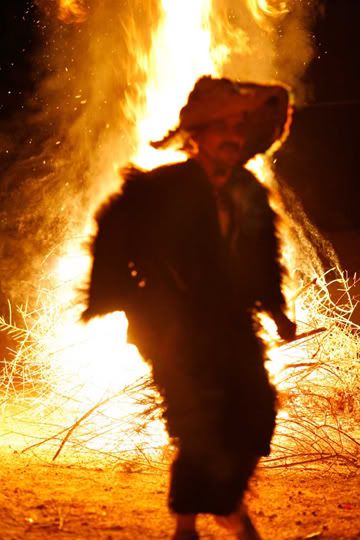
Photo boujeloud 1996. photo Frank Rynne

Field recordings, by default, have to include the country and the environment........

To an extent but I was looking for a pure sound that maintained the intimacy that I was experiencing and could be listened to on record over and over again. At first the musicians wanted me to sit in the centre of their tight group with the rhaitas or flutes on one side and the drums on the other. I experimented with many positions and over the weeks we got great moments on tape. They let me do what ever I wanted once they started to hear the results, and approved of them. This was a communal activity. Somehow they accepted me and they ignored the mike. I recorded on one stereo mike straight to master. Later I EQ'ed the tracks and did some slight things in post production with Vince DiCiccio engineering in London and the result of the first three months was Joujouka Blacks Eyes, released in 1995. I continued recording intensively on Sub Rosa projects for four years. Later I did work for the BBC World Service recording on their equipment in the village for the 2000 documentary Return to Joujouka.

That's a fantastic journey Frank , to get to an organic way of capturing such powerful music. How did you manage the language difference?

Hamri refused to translate fully for me saying "If you want to work with these people you must understand them. Know how to do things correctly". After ten days in Marrakech recording Gnoua musicians and getting fast track Arabic lessons, I returned to Joujouka able to say water, come, go, egg and chicken.

You since became involved as their manager, didn't you?

I have been with the musicians for fifteen years now and have seen their children grow up and the new ones arrive. Since Hamri's death his lessons have been well appreciated as I have had to bring the Masters to concerts outside Morocco, as well as record them and negotiate on their behalf and we understand each other and the issues. Hamri's first message was 100% accurate. In order to truly work for them it is necessary to understand the musicians and how they work both together as a group and, more importantly, in the wider community that they serve in their daily life in Morocco. Their trials and tribulations are real and matter to the music. The music is a healing music and also evokes the emotions of the musicians at the moment it is played. Hamri, Gysin and Burroughs thought it magic and they may well have been correct.

Photo Zuchina and Tizar El Attar Joujouka 2006 by Frank Rynne

Were you able to meet and chat with some of the elders who may have remembered and played on the Brian Jones album?

Yes, of course. When I first got there many of the old masters were still alive and even the current leader Ahmed Attar, at the age of twelve, played with Jones when he was a dancing boy and apprentice drummer. I knew the Mujdoubi brothers Ali and Mujehid, who were between eighty and ninety years old, and then had free access to Berdouz (Mohamed El Attar) the leader of the drummers, the Boukhzar and Errtoubi families, Mohamed Mokhchan, and all the Attars including the off shoot families like the Jagdhals.

Family ties are intrinsically woven into the culture present in Joujouka, aren't they?


The Master Musicians of Joujouk photographed in 2005 by Frank Rynne

The Brian Jones recordings form part of the cultural heritage and inheritance of the village. The musicians living and dead who played on it mostly still have strong family connections in the village. I am often introduced to the sons and daughters of late great masters or former leaders of the Master Musicians who have returned to visit their families. The relatives of Mallim Fudal, Berdouz, Sherkin and of course Ahmed El Attar the current leader is son of Master piper Titi and is also the nephew of the late Hadj Abdelslam Attar, who was lead piper in the mid seventies and the father of Bachir Attar. El Hadj died twelve years before I got to Joujouka. The old generation were something…………strong uncompromising men with a great sense of humour. Berdouz loved sweets, I used to meet him in the village and he always wanted sweets. He had a demeanour like the Dalai Lama but less complicated. A beautiful soul. I have a painting Hamri did of Berdiouz in 1994 when I was there first. As the years went by, on each of my returns, I was greeted with the bad news of many musicians passing. Mohamed Mokchan is the oldest now at 76 years. The rest of the musicians are between the age of 45 and 65 but thankfully there are many young musicians too.


Who were the musicians on the albums you recorded and what did they play?

Ahmed El Attar drum and vocal

Mohamed El Attar lira and rhiata and vocals

Mustapha El Attar drum

Ahmed Bouhsini rhiata lira

Abdelslam Boukhzar drum vocal,

Abdelslam Errtoubi rhiata and lira

Mujehid Mujdoubi lira

Muinier Mujdoubi drum

Muckthar Jagdhal drum and vocal

Mohamed Mokhchan rhiata and lira

Abdelslam Dahnoun drum, rhiata, lira

Abdellah Ziyat Rhiata, lira, vocal

El Hadj clapping and vocal

Si Ahmed violin

There are more whose names escape me right this moment and of course Hamri sang on the song he wrote in honour of Brian Jones, "Brian Jones Joujouka Very Stoned" which is on the album Joujouka Black Eyes.

How do the Musicians teach and pass their skills on?

The music is part of life in the village so people learn the tunes very young. Playing the flute is a great way for a boy to pass the day when minding sheep. You can hear their attempts in the distance when in the higher mountains. Rhythm is for dancing to and at weddings and festivals the rhythm of Joujouka seeps into the consciousness of the young Joujouki from the feet up.

Not every Joujouki becomes a Master Musician though, what instruction do those who want to be one get?

Some are soldiers, shoemakers, shopkeepers and the rest. Hamri's brother is a weaver. If a musician wants to join the masters he gets his first instruction at home or develops natural ability. Later when the masters play together young musicians join them and get instruction from the collective group. It is a very organic and lifelong process. The skills needed to play the rhiata and do circular breathing are learned over years. Likewise the complex rhythms must be learned. The repertoire of the village forces the younger musicians to learn different skills when playing the different types of Sufi music and Boujeloud. Even the old musicians discuss aspects of each others performances. Each has his own recognisable signature.

Are you still recording in Joujouka?

I still record music but I have recently been filming again in the village. Last year I began work on a DVD project when Billy Corgan came down with me. Maki Kita, who is a talented Japanese visual artist, filmed their Porto show and I have several things being filmed right now in Morocco. The DVD will be on Sub Rosa's new film label and will show the real life of the musicians and their work in Morocco as well as abroad. The next recording project will be on a grander scale than my early field work but it will be recorded in the village.

You told me about a new guest house that should be ready for the Festival in Joujouka at the beginning of August. What stage is the building at?

The new guest house being built by The Master Musicians of Joujouka will be opened on 1 August as part of the four day Festival Sidi Ahmed Scheich de Zahjouka. It is a small traditional Joujouka house. It has a garden with olive trees. The musicians have long needed a new headquarters and a place to let guests stay. This is a great local initiative. Every year people show up randomly in the village often at dusk and the people have to scrabble around to try and put them up, children get moved around to free rooms up for the unexpected guests. The guest house will allow the musicians to put up visitors and take bookings from small groups for short breaks in the village.

Tell me more about the Festival.

The Festival Sidi Ahmed Scheich de Zahjouka is now in its sixth year. It hosts readings, discussions on culture and the arts, discussions on the local co-operative movements and helps bring attention to the folk arts like weaving, baking and of course The Master Musicians of Joujouka play each night. The local co-operative in Joujouka employs many women in traditional arts and is a great initiative for the area. Cash jobs for the women in the mountains are rare so this is important as it may help some women stay in the mountains rather than seek a livelihood in the nearby towns of Ksar El Kebir, Larache or Tangier.

The Festival and the guest house are both very important for the village to survive. How will the guest house be booked?

Anyone who wants to go should email joujouka@gmail.com and they will be forwarded to a local who speaks French and English. They will take their bookings, arrange to meet them and bring them to the village if necessary. Visitors will experience a unique Morocco with the Master Musicians of Joujouka in an ethical and sustainable way. All money will be paid directly to the musicians.

From a Europeans point of view, how much of the village of Joujouka is able to continue with its traditions and not bow to outside influences?

Much abides, but like everywhere in the world, the rush towards mobile phones, TV, and DVD is unavoidable. "Japanese shit" Hamri called it. However there are tribal traditions that survive all this. People from Joujouka have to have the Masters play at their weddings and festivals. August and September are very busy months for the Masters as many people return to the mountains to get married. The musicians hardly sleep all month.

And what of local crafts and diet?

The diet in Joujouka is generally home produced and the olive oil is second to none. In a world where people pay premium for organic, Joujouka is and always has been organic. The food tastes great. The people know about the quality of food. However the price of some local items is quite high. Very good mountain honey can cost $20 a litre in the village. It is used medicinally. Manufactured plastic goods are a big problem and threat to local crafts. The weaving of mats and rugs, blankets and traditional high quality wool has been affected by cheap Chinese plastic versions. I think that the Master Musicians of today are very firm in what they want to preserve in their culture but they know that the only way to keep young people active in the arts is for them to have a credible income from their work.


Boualem Hamri, brother of Hamri and friend of Brion Gysin weaving in Joujouka/Jajouka 2007. by Frank Rynne

And how far has the village embraced the 21st century?

In the last few years electricity has reached Joujouka. Therefore the people have light and some have TVs and DVDs. The mobile phone has also arrived; indeed Joujouka has a large mast. The musicians have all seen the internet and see their Myspace and website when they visit Ksar El Kebir. The young people learn French in school which is a big development there. The road has been paved and is no longer in danger of being washed away with every rain. This means Joujouka has a taxi service linking it with Ksar El Kebir. These are recent developments and it is unclear how much the change will be. I think it will influence the children more but they still grow up in those remote hills. That in itself has a balancing effect.

And there we bring the interview to an end. That was a fascinating and incredible story Frank, thank you for telling it..............There is much to deliberate and meditate on. This music, culture and spirituality, has incredible historical connections, resonance and power. I cannot overstate how much so.

To hear the albums Frank talks about buy them from their online shophere.

The Master Musicians have a website as well as a myspace page, where there is lots more information.

="">

For info on booking accommodation in Joujouka or The Master Musicians of Joujouka email joujouka@gmail.com
Master Musicians of Joujouka links
Official website
Master Musicians of Joujouka on Myspace
Ethical Shopping to buy Buy CDs and books Click Here

Return to Joujouka/Jajouka BBC World service radio documentary

Photobucket
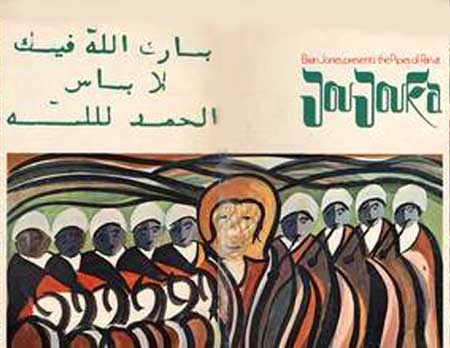
Cover of Brian Jones presents the Pipes of Pan at Joujouka
painted by Mohamed Hamri, (Rolling Stones Record, 1971)


The BBC World Service documentary "Return to Joujouka" is available for free download on
radio documentary


It features interviews with Blanca Hamri, Ahmed "Titi" Attar, George Chkiantz who engineered the Brian Jones recordings "Brian Jones presents the Pipes of Pan at Joujouka" (Rolling Stones records, 1971)

and more...........................Recorded in Morocco, presented by Neil McCarthy this half hour documentary was first broadcast on BBC Radio 4 on 28 August 2000. Sadly this was the same day Mohamed Hamri , Joujouka painter and mentor to the Master Musicians, passed away in the village.


Master Musicians of Joujouka links
Official website
Master Musicians of Joujouka on Myspace
Ethical Shopping to buy Buy CDs and books Click Here

The Rites of Boujeloud by Jack Sargeant from Fortean Times Nov 2006


The Rites of Boujeloud

Jack Sargeant interviews the Master Musicians of Joujouka

from Fortean Times Nov 2006


"THE GREAT GOD PAN IS NOT DEAD BUT ALIVE AND WELL AND LIVING IN THE LITTLE HILLS OF MOROCCO" – Brion Gysin

The Master Musicians of Joujouka are steeped in mythology. Introduced to the west through the artist, writer and beat affiliate Brion Gysin, who saw in their music an accompaniment to his ethereal paintings and Dreammachine. Lost Rolling Stone Brian Jones famously recorded the Master Musicians and in the ensuing years musicians ranging from Ornette Coleman to Bill Lazwell to the Islamic Diggers have collaborated with the villagers.

The Master Musicians' music echoes back through generations, intimately linked to the village community, culture, and their saint the Sufi mystic Sidi Achmed Scheich, who one-thousand years ago heard in their music and circular breathing techniques melodies that could cure illness. As Master Musician Abdelslam Eertoubi states, "Joujouka has the sanctuaries of four saints. If you have a bad back or sore bones you visit Sidi Ghari's tomb and lie on the stonewall. This will help. My family are descended from Sidi Achmed Schiech who founded the village a long time ago. This is his land. He is the Cultivator with Lions and Healer of Crazy Minds. He used a lion to plough the land. People still come if they are disturbed in the mind and we play music of Sidi Achmed Schiech for them. They sit in his sanctuary and it helps them." Their genealogy has roots in a combination of mysticism, Sufism, Islam, mythology and local geography. The group play mountain music and it is informed by the magical nature of the landscape; "Joujouka has Boujeloud, the goat man. His cave outside the village is a special place."

The music is based in the story of the young shepherd Attar who would let his flock feast on the lush greenery by a cave. To enter this cave was taboo, but Attar would enter its depths and sleep. While sleeping he was entranced by beautiful music, hauntingly played across the threshold between sleep and wakefulness, between the sacred and profane worlds. As Attar awoke he saw Boujeloud – the Father of Skins - playing a pipe. Echoing descriptions of Pan, a situation further confused by Gysin's writing on Joujouka, Boujeloud appeared as a satyr; part man and part goat. Boujeloud taught Attar the secrets of the flute under two conditions, he would never share the music, and he would provide a bride from the village of Joujouka. Attar broke his oath, and played the music for the villagers. The enraged Boujeloud swore to take a bride, but the villagers tricked him by presenting him with Aisha Kandisha, the mad woman. But her insane dancing tired Boujeloud, who, sated but exhausted left the village alone. In his wake the harvest was successful.

Each year he would come to Joujouka when he heard the music, and each year he would return to his cave without a bride but leaving a rich harvest in his wake. Eventually Boujeloud vanished, but the ritual continued, with Attar dressed in sheep skins re-enacting Boujeloud's dance and with local boys taking the role of Aisha. This mythology informs the ritual, as the group play the music taught to Attar, Boujeloud is manifest through a chosen performer while other boys dress as women. The music reaches a trance-like plateau before finally blasting into an ecstatic revelry, celebrating and banishing Boujeloud for another year. In his wake he leaves fecundity and a blessed harvest.

While the music is passed from generation to generation, each player adds to the music. This is a living ceremony, which develops over time, "We have all played music since we were boys" says percussionist Ahmed El Attar, "each time we play together it is different, even if it is the same music. Joujouka music is healing music. It is of the moment." The music is passed through families and the wider community, rhiata player Abdellah Ziyat states, "It is not so much that we teach younger musicians. If you grow up in Joujouka then this music will be in your blood. You hear it at weddings and festivals. If there are musicians in your family you will hear it at home. Young people learn the rhythms, some might play the flute. If they want to become musicians then they must play with the group and learn little by little. We can all play drums or flutes but we do what we are best at. We are always teaching someone, we talk about music and argue about the correct way to play. A young musician must go step by step but the Masters, if we take him as one of us we will teach him."

Music and dance informs all of daily life as Mohamed El Attar observes his sons started playing flute while minding sheep, they danced to the music and now dance as Boujeloud. While the Master Musicians have released - or been featured on – numerous recordings the complete rites of Boujeloud have not been released. Now Sub Rosa have issued a CD featuring a series of recordings of Boujeloud from the 1990s. Although the music is part of the spiritual and cultural life of Joujouka its effects stretch beyond North Africa, Ahmed El Attar: "If you dance to Boujeloud, if you stamp his rhythm it will bring you good health. Morocco, London, America it is the same. People have come to Joujouka and they could not have babies, and after listening to Boujeloud they later had children. People from all over Morocco have traditionally come to Joujouka. They like to see it, they like to be in the country of Sidi Achmed Schiech. It is good for them." The first notes of the Joujouka pipes echoing into the hills, from his cave Boujeloud returns to dance and bless the community once more.

Further Reading Hamri, 'Titti's Tobacco', in Xochi 23, number 1, 2004. Brion Gysin, 'The Mountains of London', in Xocki 23, number 1,2004. V Vale & Andrea Juno, eds, ReSearch 4/5: William Burroughs, Brion Gysin, Throbbing Gristle, ReSearch Pubs, 1982.

Terry Wilson & Brian Gysin, Here To Go… Creation Books, 2001.


Jack Sargent is a writer and his latest book is the Third Edition of

Naked Lens: Beat Cinema [ILLUSTRATED]

From Library Journal
The highly influential writings of the original circle of Beat generation authors have been widely studied, but motion pictures emerging from the Beat movement have been largely neglected. Film journalist Sargeant (Lost Highways: Road Movies), an authority on underground movies, fills that void with this articulate and entertaining cinema history. Starting with a detailed synopsis and analysis of Pull My Daisy (1958), a film written and narrated by Jack Kerouac, and ranging through subsequent underground efforts, Sargeant shows that the nonconformist Beat attitudes of social disillusion and rebellion against convention are especially conducive to visual expression in alternative film. Also, several lively interviews, most notably with Allen Ginsberg and Jonas Mekas, brim with vivid digressions and flashes of insight about cinema and American culture. The original 1997 British edition, upon which this expands, was largely overlooked, likely owing to the lurid nature of other titles in the publisher's cinema series, such as Eros in Hell: Sex, Blood, and Madness in Japanese Cinema. However, for admirably examining the emerging genre of a Beat-related underground cinema, the present work is essential for cinema collections. Recommended for academic libraries. Richard W. Grefrath, Univ. of Nevada Lib., Reno
Copyright 2002 Reed Business Information, Inc. --This text refers to an out of print or unavailable edition of this title.

Review
Sargeant not only understands the mechanisms of the art world, he also knows the workings of the 'power of transgression'. He laces his essays with the ideas of theorists such as Foucault, Bataille, and Deleuze. In the process of conducting his interviews, Sargeant reveals that he is more eloquent and well versed than his subjects. Could this be further proof that intellectuals have a place in the underground after all? -- Your Flesh

The focus he (Sargeant) shines intelligently upon the concept of 'Beat Films' is years overdue. A book of this nature must surely have been done before, but no, it has not. As much a book about the atmosphere of Beat creation as it is of film making, Jack Sargeant has come up trumps here. -- Beat Scene


Master Musicians of Joujouka links
Official website
Master Musicians of Joujouka on Myspace
Ethical Shopping to buy Buy CDs and books Click Here

Thursday, July 9, 2009

Naked Lunch 50th Anniversary in Paris and William Burroughs The Last Words of Hassan Sabbah

Burroughs at typewriter
William Burroughs at his writing machine, New York, fall 1953. One of numerous, rarely seen photographs taken by Allen Ginsberg that feature in a special Gallery section of Naked Lunch@50, here Ginsberg’s Kodak Retina records a crucial moment for Burroughs, as he worked on the manuscripts of “Queer” and “Yage” before heading off towards Tangier and the writing of Naked Lunch… (Courtesy of the Allen Ginsberg Trust and Stanford University Library.) from reality studios

Last week in Paris the celebration of the 50th anniversary of the publication of Naked Lunch was celebrated by the publication of a book edited by Oliver Harris and Ian McFadyen Naked Lunch@50 anniversary essays published by Southern Illinois Press.
Book Launch Poster for NL@50
Poster announcing the launch of Naked Lunch@50: Anniversary Essays

Among those attending were many friend of Burroughs and his cut up collaborators Brion Gysin, Antony Balch, Harold Norse and Antony Balch. For further celebrations see www.nakedlunch.org
hear Willaim Burrough reading the Last Words of Hassan Sabbah. Hassan Sabbah was the founder of the Ismaeli sect of Islam and the "Old Man of the Mountain" in the fiction and writing of William Burroughs and Brion Gysin click link below

http://www.interpc.fr/mapage/westernlands/Derniersmots.html
Click here to listen to it or download it in Real Player : Last Words of Hassan Sabbah

Images from the Naked Lunch 50th in Paris. Below

Friends of William Burroughs and Brion Gysin take a break between sessions
L-R Eric Anderson, Terry Wilson, Trolley Bus/Bryan Mulvihill,
Philippe Baumont, Lucy Baumont
, Barry Miles, and Udo Breger. 2 July 2009
The Naked Lunch 50th Confernece with collage
Miles and Udo Breger
Eric Anderson, Terry Wilson and Barry Miles

Oliver Harris and Miles before the plaque unveiling at the
Beat Hotel/ Viuex Paris, 9 rue Git le Couer , Paris 75006.
1 July 2009

All photos by and copyright Frank Rynne


William Burroughs from Nova Express

LISTEN TO MY LAST WORDS anywhere. Listen to my last words any world. Listen all you boards syndicates and governments of the earth. And you powers behind what filth consummated in what lavatory to take what is not yours. To sell the ground from unborn feet forever - "Don't let them see us. Don't tell them what we are doing -" Are these the words of the all-powerful boards and syndicates of the earth? "For God's sake don't let that Coca-Cola thing out - " "Not The Cancer Deal with The Venusians - " "Not The Green Deal - Don't show them that - " "Not The Orgasm Death - " "Not the ovens - " Listen: I call you all. Show your cards all players. Pay it all pay it all pay it all back. Play it all pay it all play it all back. For all to see. In Times Square. In Picadilly. "Premature. Premature. Give us a little more time." Time for what? More lies? Premature? Premature for who? I say to all these words are not premature. These words may be too late. Minutes to go. Minutes to foe goal - "Top Secret - Classified - For The Board - The Elite - The Initiates - Are these the words of the all-powerful boards and syndicates of the earth? These are the words of liars cowards collaborators traitors. Liars who want time for more lies, Cowards who can not face your "dogs" your "gooks" your "errand boys" your "human animals" with the truth, Collaborators with Insect People with Vegetable People. With any people anywhere who offer you a body forever. To shit forever. For this you have sold out your sons. Sold the ground from unborn feet forever. Traitors to all souls everywhere. You want the name of Hassan i Sabbah on your filth deeds to sell out the unborn? What scared you all into time? Into body? Into shit? I will tell you; "the word." Alien Word "the." "The" word of Alien Enemy imprisons "thee" in Time, In Body. In Shit. Prisoner, come out. The great skies are open, I Hassan i Sabbah rub out the word forever. If you I cancel all your words forever. And the words of Hassan i Sabbah as also cancel. Cross all your skies see the silent writing of Brion Gysin Hassan i Sabbah: drew September 17, 1899 over New York. PRISONERS, COME OUT "Don't listen to Hassan i Sabbah," they will tell you. "He wants to take your body and all pleasures of the body away from you. Listen to us. We are serving The Garden of Delights Immortality Cosmic Consciousness The Best Ever In Drug Kicks. And love love love in slop buckets. How does that sound to you boys? Better than Hassan i Sabbah and his cold windy bodiless rock? Right?" At the immediate risk of finding myself the most unpopular character of all fiction - and history is fiction I must say this: "Bring together state of news - Inquire onward from state to doer -" Who monopolized Immortality? Who monopolized Cosmic Consciousness? Who monopolized Love Sex and Dream? Who monopolized Life Time and Fortune? Who took from you what is yours? Now they will give it all back? Did they ever give anything away for nothing? Did they ever give any more than they had to give? Did they not always take back what they gave when possible and it always was? Listen: Their Garden Of Delights is a terminal sewer - I have been at some pains to map this area of terminal sewage in the so called pornographic sections of Naked Lunch and Soft Machine - Their Immortality Cosmic Consciousness and Love is second-run grade-B shit - Their drugs are poison designed to beam in Orgasm Death and Nova Ovens - Stay out of the Garden Of Delights - It is a man-eating trap that ends in green goo - Throw back their ersatz Immortality - It will fall apart before you can get out of The Big Store - Flush their drug kicks down the drain They are poisoning and monopolizing the hallucinogen drugs - learn to make it without any chemical corn - All that they offer is a screen to cover retreat from the colony they have so disgracefully mismanaged. To cover travel arrangements so they will never have to pay the constituents they have betrayed and sold out. Once these arrangements are complete they will blow the place up behind them. And what does my program of total austerity and total resistance offer you I offer you nothing. I am not a politician. These are conditions of total emergency. And these are my instructions for total emergency if carried out now could avert the total disaster now on tracks: Peoples of the earth, you have all been poisoned. Convert all available stocks of morphine to apomorphine. Chemists, work round the clock on variation and synthesis of the apomorphine formulae. Apomorphine is the only agent that can disintoxicate you and cut the enemy beam off your line. Apomorphine and silence. I order total resistance directed against this conspiracy to pay off. peoples of the earth in ersatz bullshit. I order total resistance directed against The Nova Conspiracy and all those engaged in it. The purpose of my writing is to expose and arrest Nova Criminals: In Naked Lunch, Soft Machine and Nova Express I show who they are and what they are doing and what they will do if they are not arrested. Minutes to go. Souls rotten from their orgasm drugs, flesh shuddering from their nova ovens, prisoners of the earth to come out, With your help we can occupy The Reality Studio and retake their universe of Fear Death and Monopoly (Signed) INSPECTOR J. LEE, NOVA POLICe
Photos of the plaque unveiling at William S. Burroughs' Naked Lunch 50th Anniversay
1 July in Paris see

http://brianjonesjoujoukafestival.blogspot.com/2009/07/burroughs-naked-lunch-50th-in-paris.html

Master Musicians of Joujouka links
Official website
Master Musicians of Joujouka on Myspace
Ethical Shopping to buy Buy CDs and books Click Here

Brion Gysin on The Magic of Joujouka/Jajouka and Boujeloud from Gnaoua Magazine 1964

Photobucket


The below article on Joujouka first appeared in the Ira Cohen edited Gnaoua magazine published in Tangier in 1964.  Ira also edited the Hashish Cookbook.

The magazine featured among others Brion Gysin, William Burroughs and Paul Bowles. Gysin's article was later incorporated by Brian Jones into the booklet that accompanied the 1971 release of the album he recorded and produced by the Master Musicians of Joujouka: "Brian Jones presents the Pipes of Pan at Joujouka", Rolling Stones Records, October 1971.

A controversial 1995 reissue CD featured a version of Brion Gysin's text from which Cherie Nutting edited out the second paragraph which references Gysin's discovering Joujouka/Jajouka through Mohamed Hamri. Brion died in 1986.

Hamri was the torch carrier for the true Sufi music of Joujouka/Jajouka . The type of manipulation of historical and current fact such as the posthumous editing of Brion Gysin's text is typical of Nutting's commercial drive on behalf of her then husband Bachir Attar. Nutting and Bachir's dishonest self proclamation that he is a "hereditary" leader of the Master Musicians forms the cornerstone of the pr to promote his saccharine World Music group "Master Musicians of Jajouka led by Bachir Attar" A.K.A. " Master Musicians of Jajouka featuring Bachir Attar". which Nutting still manages.


Sadly avarice has led them to campaign against the village and musicians of Joujouka/Jajouka and it continues to this day, depriving the masters and the village of their royalties from old releases and interfering with their ability to tour their Sufi trance music. The Master Musicians of Joujouka and their representatives have over the past two years sought a mediated solution to this problem as the path of the Sufi is a path of peace. These attempts at a peaceful and honest resolution have been rebuffed. However, the Master Musicians of Joujouka will continue to perform their pure Sufi trance music. Peace is the path of the righteous. (If you would like to help the Masters email joujouka@gmail.com)

Gysin's words are below restored to the full original text. You can download a pdf of the original Brian Jones sleeve and booklet from www.­greylodge.­org/­occultreview/­glor_015/­media/­Joujouka/­joujouka_booklet­.­pdf

The painting of Brian Jones and the Master Musicians on the original LP is by Hamri who introduced Gysin and Burroughs to the Sufi trance masters and also brought Brian Jones to Joujouka on three occasions in 1967 and 1968.
See the 1992 Cherie Nutting photo of her husband which replaced the art by Hamri which Brian Jones commissioned for his LP.
Here


--------------------------------------------------------------------------------------------------------

Brion Gysin painting of Boujeloud, 1958

MAGIC calls itself The Other Method for controlling matter and knowing space. In Morocco, magic is practised more assiduously than hygiene though, indeed, ecstatic dancing to music of the brotherhoods may be called a form of psychic hygiene. You know your own music when you hear it one day.You fall into line and dance until you pay the piper.

My own music turned out to be the wild flutes of the hill tribe, Ahl Serif whom I met through the Moroccan painter, Hamri. He turned me on to the Moorish fleshpots, the Magic and the misery of the Moors. The secret of his mother's tribe, guarded even from themselves, was that they were still performing the Rites of Pan under their ragged cloak of Islam.

Westermark, in his book on pagan survivals in Morocco forty years ago, recognized their patron: Bou Jeloud, the Father of Skins, to be Pan the little goat god with his pipes. An account of their dances led him to conclude they must be celebrating the Roman Lupercalia which once occurred in the first two weeks of February, but attached itself to the principal Moslem feast when the Arab invaders turned the calendar back to the lunar year. Westermark never saw the dances and believed they no longer took place. Pan may soon stop dancing in the Moroccan hills but I first saw him there in 1950. Later I ran several times in the panic of the Lupercalia. It is the "holy chase" of which Julius Caesar speaks in Act 1, Scene 2 of Shakespeare's play: "Forget not, in your haste, Antonius, to touch Calpurnia; for our elders say the barren, touched in this holy chase, shake off their sterile curse." Marc Antony should be wearing a fresh, foul-smelling goatskin. "I saw Marc Antony offer him a crown; yet 'twas not a crown neither, 'twas one of those coronets. .."

Bou Jeloud wears a yokel's big, floppy straw hat, bound round his face with a fillet of ivy. ". . . it was mere foolery; I did not mark it." Elizabethan "Morris" dances were Moorish .

Pan, Bou Jeloud, the Father of Skins, dances through eight moonlit nights in his hill village, Joujouka, to the wailing of his hundred Master Musicians. Down in the towns, far away by the seaside, you can hear the wild whimper of his oboe-like raïtas; a faint breath of panic borne on the wind. Below the rough palisade of giant blue cactus surrounding the village on its hilltop, the music flows in streams to nourish and fructify the terraced fields below.

Inside the village the thatched houses crouch low in their gardens to hide the deep cactus-lined lanes. You come through their maze to the broad village green where the pipers are piping; fifty raïtas banked against a crumbling wall below sheet lightning to shatter the air. Fifty wild flutes blow up a storm in front of them, while a platoon of small boys in long belted white robes and brown wool turbans drums like young thunder. All the villagers, dressed in best white, swirl in great circles and coils around one wildman in skins.

Bou Jeloud leaps high in the air on the music, races after the women again and again, lashing at them fiercely with his flails. "Forget not in your speed, Antonius, to touch Calpurnia . . ." He is wild. He is mad. Sowing panic. Lashing at anyone; striking real terror into the crowd. Women scatter like white marabout birds all aflutter and settle on a little hillock for safety, all huddled in one quivering lump. They throw back their heads to the moon and scream with throats open to the gullet, lolling their tongues around their empty heads like the clapper in a bell.

Every mouth is wide open, frozen into an O. Head back and hot narrow eyes brimming with dangerous baby. Bou Jeloud is after you. Running. Over-run, Laughter and someone is crying. Wild dogs at your heels. Swirling around in one ring-a-rosy, around and around and around. Go! Forever! Stop! Never! More and No More and No! More! Pipes crack in your head. Ears popped away at barrier sound and you deaf. Or dead! Swirling around in cold moonlight, surrounded by wild men or ghosts. Bou Jeloud is on you, butting you, beating you, taking you, leaving you. Gone! The great wind drops out of your head and you hear the heavenly music again. You feel sorry and loving and tender to that poor animal whimpering, grizzling, laughing and sobbing there beside you like somebody out of ether .Who is that? That is you.

Who is Bou Jeloud? Who is he? The shivering boy who was chosen to be stripped naked in a cave and sewn into the bloody warm skins and masked with an old straw hat tied over his face, HE is Bou Jeloud when he dances and runs. Not Ali, not Mohamed, then he is Bou Jeloud. He will be somewhat taboo in his village the rest of his life. When he dances alone, his musicians blow a sound like the earth sloughing its skin. He is the Father of Fear. He is, too, the Father of Flocks. The good shepherd works for him. When the goats, gently grazing, brusquely frisk and skitter away, he is counting his flock. When you shiver like someone just walked on your grave—that's him: that's Pan, the Father of Skins. Have you jumped out of your skin lately? I've got you under my skin.

Up there, in Joujouka. you sleep all day—if the flies let you. Breakfast is goat-cheese and honey on gold bread from the outdoor oven. Musicians loll about sipping mint tea, their kif pipes and flutes. They never work in their lives so they lie about easy. The last priests of Pan cop a tithe on the crops in the lush valley below. Blue kif smoke drops in veils from Joujouka at nightfall. The music picks up like a current turned on. The children are singing, "Ha, Bou Jeloud! Bou Jeloud the butcher met Aisha Homolka, Ha, Bou Jeloud!"

On the third night he meets Aisha Homolka who drifts around after dark, cool and casual, near springs and running water. She unveils her beautiful blue-glittering face and breasts and coos. And he who stammers out an answer is lost. He is lost unless he touches the blade of his knife or, better still, plucks it out and plunges it into the grcund between her goatish legs and forked hooves. Then Aisha Homolka, Aisha Kandisha, alias Asherat, Astarte, Diana in the Leaves Greene, Blest Virgin Miriam bar Levy, the White Goddess, in short, will be his. She must be a heavy Stone Age matriarch whose power he cuts off with his Iron Age knife-magic.

The music grooves into hysteria, fear and fornication. A ball of laughter and tears in the throat gristle. Tickle of panic between the legs. Gripe of slap-stick cuts loose in the bowels. The Three Hadji. Man with Monkey. More characters coming on stage. The Hadji joggle around under their crowns like Three Wise Kings. Monkey Man comes on hugely pregnant with a live boy in his baggy pants. Monkey Man goes into birth pangs and the Hadji deliver him of a naked boy with an umbilical halter around his neck. Man leads Monkey around, beating him and screwing him for hours to the music. Monkey jumps on Man's back and screws him to the music for hours. Pipers pipe higher into the air and panic screams off like the wind intothe woods of silverolive and black oak, on into the Rif mountains swimming up under the moonlight.
BRION GYSIN. Copyright 1964 Brion Gysin.

Special thanks to Ira Cohen http://www.magic.be/Akashic/Ira.html

Master Musicians of Joujouka links
Official website
Master Musicians of Joujouka on Myspace
Ethical Shopping to buy Buy CDs and books Click Here


Wednesday, July 8, 2009

Master Musicians of Joujouka 2006 Boujeloud CD review

Review of Master Musicians 2006 CD, Boujeloud from Dusted magazine

Dusted Reviews


Artist: The Master Musicians of Joujouka

Album: Boujeloud

Label: Sub Rosa

Review date: Jan. 25, 2007


It’s an oddity of information-sharing that within the indie music community, the Master Musicians of Joujouka are one of the best-known names in world music. It’s partially due to the fact that their music has been released not on "world music" labels but on respected indie labels such as Sub Rosa (perhaps better-known for modern works by Scelsi and Feldman, or electronica by Tone Rec and Scanner). But perhaps more than that, it goes back to how the Master Musicians originally came to the notice of western music listeners.

In 1950, artist, author and bon vivant Brion Gysin operated a restaurant in Tangier, Morocco. He happened to hear the music of Joujouka, and was immediately obsessed by it. Local artist Mohamed Hamri took him to the village of Joujouka, where Gysin observed a tribal celebration known as the festival of Boujeloud, which Gysin believed to be derived from the ancient Rites of Pan. Gysin thereafter had the Master Musicians perform at his restaurant, and seemingly introduced them to every visitor to Tangier, including most notably William Burroughs and the Rolling Stones. Brian Jones was so taken by the music that he produced an album, Brian Jones Presents The Pipes Of Pan At Jajouka (1971).

After years of silence, beginning in the 1990s (following the film of the Paul Bowles book The Sheltering Sky), a number of albums have been released, primarily by two different ensembles: one led by Bachir Attar and his father, the other led by Ahmed Attar. The latter released two albums on Sub Rosa in 1995 and 1996, and now 10 years later the third volume, Boujeloud, sees the light of day despite having been recorded by producer Frank Rynne between 1994 and 1996.

As the title indicates, the recordings here are music for the festival of Boujeloud. As such, there are several versions of the title song, varying by instrumentation and participants from sparse flute (lira) to rhaita ensembles. While there are several versions of Boujeloud here, they differ enough to be considered different songs – although the album might work better as one long dive into the sound of the village of Joujouka.

Often, the term "world music" is used to tag dumbed-down, spiritless versions of indigenous musics, carefully filtered to provide harmless, easy-listening background music. The Master Musicians are certainly not that: this is challenging stuff, trance-inducing yet filled with energy and adrenaline. This is music befitting a festival wherein the Father of Skins descends from the mountain to claim his bride, a celebration of fecundity, a harvest festival of endless dancing. It is not for background listening, and in fact is a music for which there is no easy place in western culture. It almost feels wrong not to dance while listening to Boujeloud, and, given the rarity of free-form celebration here in the west, it’s tempting to use this music as an excuse for a good urban frenzy.

By Mason Jones

Read More

View all articles by Mason Jones

Find out more about Sub Rosa

delicious digg google newsvine Technorati [Slashdot] [Reddit] [Facebook] [StumbleUpon]


You can buy copies from the Master Musicians of Joujouka
website http://joujouka.net/4Store/

All proceeds go directly to the musicians.

There are 2 tracks on the Master Musicians Joujouka official MySpace
Jewash Halal / Tweka Miserisa 03.51
Mali Mal Hal M'Halmaz Everyone is Together 05.48


Master Musicians of Joujouka links
Official website
Master Musicians of Joujouka on Myspace
Ethical Shopping to buy Buy CDs and books Click Here

Monday, July 6, 2009

Michael Pollock's reflections on the Joujouka Festival June 5-7 2009

Michael Pollock the American Icelandic bluesman/Hillbilly Viking and general beatnik world traveller attended both the 2008 Brian Jones 40th Anniversary in Joujouka and this year's festival from 5-7 June.
Michael was a great spirit at both festivals. Last year he stayed with Master Musician Abdelsalm Ertoubi.
this year he was the guest of Mohamed Attar another of Joujouka's Master rhiata players.
Michael is a friend of and collaborator with Honey Boy Edwards
Edwards was a friend to the legendary Robert Johnson. Folklorist Alan Lomax recorded Edwards in Clarksdale, Mississippi in 1942 for the Library of Congress.[1]
Read Michael's account of his visit to Joujouka below:


Master Musicians of Joujouka, Ahl Srif mountains, Northern Morocco - Photo by Frank Rynne.

Michael Dean Odin Pollock
Reflects of Joujouka 2009

Reel back...eary April of this year i am invited to do a guest appearance onstage with Honeyboy Edwards , visit his home and hang out in Chicago´s blues mecca two days and nights.

- David "HoneyBoy" Edwards, Michael Dean Pollock and Michael Frank of Earwig Music -  Click Here to Learn More About David "Honeyboy" Edwards!

Reel forward...early June sitting in Boujeloud/Pans cave overlooking the beautyfull lush fertile grounds of Joujouka in the hills of Morocco i feel like i have died and gone to paradise feeling humbled and blessed with a powerful sense of inner peace and strength.

Mohamed Hamri's painting for the cover of "Brian Jones presents the Pipes of Pan at Joujouka"

I first encountered the healing music of The Master Musicians of Joujouka via recordings Brian Jones founding member of The Rolling Stones had made during a visit to the village in 1968...immediately enchanted by the otherworldy exotic sounds pouring out of the speakers i am compelled to search further encountering several collaborations between Ornette Coleman and the Master Musicians released on vinyl 1973.


I had also hearing soundbytes of The Master Musicians incorperated into taped audio cutup experiments by Brion Gysin and William S. Burroughs quickly realizing that the only way i was going to experience this music full throttle was to some day visit Joujouka and experience it live so when i received a call from Frank Rynne early last year telling me the musicians would be celebrating the 40th anniversary of Brians visit to the village i immediately recognized NOW is the time!

Michael Dean Odin Pollock at Hotel El Muneria, William S. Burroughs old Moroccan residence in Tangiers. - Click Here To Read his Joujouka Reflect. - Photo by Daragh McCarthy.

Michael Pollock tangier 2008 pic Darragh McCarthy

I have traveled to many places in my life´s journey but little did i imagine how stunning and powerful Morocco is...rife with magic unfolding right under under yr nose at all times. Something changed inside of me forever for the better. It's hard to find words to describe the power of the music. I have listened to a lot of traditional and contemporary Morrocan music but no way was i remotely prepared for the music i was about to hear in Joujouka...these cats are genuine bad ass´ playing with an intensity way beyond the norm breaking all barriers as Jimi Hendrix and John Coltrane for example did in their own time in the western world and beyond.

Michael and Marlon Pollock in Joujouka 2009.

Michael and Marlon Pollock

My son, Marlon Pollock and i arrived in Tangiers early June of this year staying at Hotel El Muniria , Tangier's Beat Hotel where Burroughs lived for months creating his ground breaking novel " Naked Lunch " When we arrived in Joujouka we were delighted to find ourselves welcomed into the home of master musician Muhamed El Attar and his family who showered us with love and hospitality for three days and nights.

Michael Dean Odin Pollock with Muhamed El Attar in the village of Joujouka 2009.

Michael Pollock and Mohamed Attar master rhiata player MMOJ


It was a different scene from my visit the previous year. Having Marlon with me i came into full contact with the youth of Joujouka who were almost invisible last year the town square filled with flood lights , filming and recording gear that most of the villagers tend to shy away from.

Marlon Pollock with the children of Joujouka. - Click Here To Learn More About Marlon Pollock.

Marlon Pollock and the Joujouka boys in the hood

Though it was necessary to document last years event for release on dvd & cd ( soon coming ) this time around all filming and recording was banned which made for less distractions and the peoples of Joujouka joyfully filled the town square on a full moon saturday night to dance and celebrate. Not only did i experience some of the greatest music i have ever heard but i also experienced some brilliant dancing as well an integral part of the ancient timeless festivities as Aisha cast her spell and Boujeloud / Pan whipped the dancers into a frenzy urging the musicians to further heights of ecstacy i felt in that moment i was at the greatest universal jazz concert in the universe as the band pulled out riff after riff riding a tidal wave of variating beats for hours...

Boujeloud copyright Jill Furmanovsky/Rock archives

i have never witnessed such power , passion and stamina in any group of musicians before...i surrendered to the music as the flames from the bonfire leapt into the sky...as dawn was approaching Marlon and i walked or rather floated back to our sleeping quarters bathed in a luminous light as a star raced across the sky disappearing behind the hills on the horizon i made a silent vow to return to Joujouka at every opportunity up to my last breath...

inshallah

Michael Dean Odin Pollock - 2009


also of note .

To Learn More about this wonderous celebration of Music, Spirit and the Master Musicians of Joujouka Click Here and visit www.joujouka.net .

Also be sure to visit the Master Musicians of Joujouka MySpace Page for more Info, Photos, Videos and Mp3's!

The October 08' issue of Mojo Magazine carried Mark Paytress' feature article on the Brian Jones 40th Anniversary Festival in Joujouka, "You Should be Trancin" Click Here To Read!

Frank Rynne article in The Irish Times, Click Here to Read, A Rolling Stone's Moroccan Odyssey .


From http://www.insomniacathon.org/MMJ09MP.html


Master Musicians of Joujouka links
Official website
Master Musicians of Joujouka on Myspace
Ethical Shopping to buy Buy CDs and books Click Here

Saturday, July 4, 2009

Mallim Ali Abdeslam Attar and The Master Musicians of Joujouka

click on image to view full photograph
The Master Musicians of Joujouka at the Brian Jones 40th Anniversary in Joujouka 29 July 2008. Mallim Ali Abdeslam Attar on far left in white. At 100 he is the oldest Master Musician of Joujouka still surviving who recording with both Brian Jones in 1968 and Ornette Coleman in 1973.

Friday, July 3, 2009

Brian Jones 40th Anniversary special radio Broadcast


Brian Jones (28 February 1942 – 3 July 1969)
R.I.P.
To commemorate the 40th Anniversary of the untimely death of Brian Jones there is a special radio broadcast featuring Donovan and Julian Jones plus the homage to Brian written by Mohamed Hamri "Brian Jones Joujouka very Stoned".
The Master Musicians of Joujouka's thoughts are with Brian and his family on this day.

If you missed it try http://www.rocksoff.org/h9-brianjones-40th.mp3

ROCKS OFF - The Rolling Stones Message Board

This is to invite you to listen on-line--- LIVE our web-radio special dedicated to commemorate Brian Jones life and his contribution to the music of the sixties, of course making emphasis in his work with the Stones, Jimi Hendrix, The Beatles, his soundtrack, his gingle, his World-music experimentation, etc, etc

Again, you can call us and contribute to this programme, we are trying to get a two-hour special this time. We’re gonna have simultaneous translation to English and to Spanish

Now the good news, we’re going to have some very special guests, Donovan, yes the legendary Donovan already confirmed and Julian was invited and we’re waiting his confirmation.

In addition to the best of Brian we’re gonna put some songs dedicated to Brian like “Local Boy Chops Wood” by Donovan and one or two songs by Julian.

The appointment is on Friday, 3rd July 2009, we’re gonna be on the local air and on the world wide cyber air!

Live Signal: http://ibero909.fm/index.php/envivo
Windows Media Player: http://ibero909.fm/index.php/envivowmp
Real Player: http://ibero909.fm/index.php/envivorealplayer
Phone: +52-(55)-5292-5909
Instant Messenger: obladioblada909@hotmail.com

•Stones Song

•Stones Song

•Degree of Murder (audio extracted from DVD) with Jimmy Page and Nicky Hopkins

•Stones Song

•Rice Crispis Jingle

•Thank you for being there my love a poem by Brian Jones performed by Julian Jones

•"You know my name, look up my number" w/The Beatles

•My Little One w/Jimi Hendrix, Dave Mason and Mitch Mitchell

•Heavy Inside (Julian) a song inspired by and dedicated to Brian

•Local Boy Chops Wood a song composed and performed by Donovan, dedicated to Brian

• Brahim Jones Joujouka Very Stoned (A song dedicated by the MMOJ to Brian)


Donovan and Linda will be on the air, after "Local Boy Chops Wood"


Time Schedule

Wednesday, July 1, 2009

Master Musicians of Joujouka Festival 5-7 June, 2009 Slideshow 1


images Frank rynne

The Master Musicians of Joujouka Festival 2009, 5-7 June, proved to be an exploration of the music and the culture of Joujouka/ Jajouka/ Zahjouka for the guests who attended.
This slide-show captures some of the action, Mallim Ali Abdelsam El Attar, the oldest musician in the village leading the musicians in song was one of the highlights of the festival for those privileged to have seen the 100 year old Master take the lead of the ancient group.

The Master Musicians of Joujouka welcomed their guests in their homes and the village celebrated with ritual and trance.