JOUJOUKA (VIA JOHNNY CASH) Interview with Master Musicians of Joujouka producer and current manager Frank Rynne by Paul Hawkins

Ahmed Attar leader of Master Musicians of Joujouka dancing 1968 All rights Master Musicans of Jououka. Contact: joujouka@gmail.com
Paul Hawkins interviews Frank Rynne on the world's oldest Rock' n' Roll band : The Master Musicians of Joujouka
The Master Musicians of Joujouka were first promoted in Western literature by William Burroughs in the 1950s. Since they first attracted the attention of Burroughs' sidekick Brion Gysin in the early fifties, The Master Musicians of Joujouka have been feted and visited by a host of cultural luminaries including Paul Bowles, Brian Jones, Acid guru Timothy Leary, who wrote an essay on his trip in Jail Notes (1971), Ornette Coleman, The Rolling Stones, and latterly by producers Bill Laswell and Frank Rynne. The most recent celebrity to receive the musicians' hospitality in Joujouka (or Jajouka) was Smashing Pumpkins leader Billy Corgan who Rynne accompanied to the remote mountain top in 2006.
Rynne's Joujouka experiences are different from many westerners. Rynne, like Brion Gysin, who spent 23 years in Morocco so as to be close to the musicians, has kept up his contact and made dozens of visits to the village over the past fifteen years. Like Brion Gysin he was a friend of the Moroccan painter Mohamed Hamri who first brought his native village and their Master Sufi trance musicians to the notice of the Western avant garde. Rynne's knowledge of the village, the music, culture and the individual villagers is unparalleled.
I caught up with Frank Rynne to find out about his work with the Master Musicians of Joujouka, which is soon to enter its sixteenth year. Frank talks about recording three CDs, radio shows, films and soundtracks in Joujouka, as well as managing the Master Musicians of Joujouka.
*************************
Being a fan of William Burroughs, Frank, getting to visit the Master Musicians in their home village of Joujouka must have been amazing. The village is linked closely to the Tangier Beat Generation; tell me about your first time out there.
There had been a bit of journey to get to that point. I don't think Burroughs was on my mind when I eventually got there. Not at first in any case. It took a few weeks to absorb the reality and put it into the context of things that I had read. At my side through my first adventures in Joujouka was Mohamed Hamri who was himself the equal to anyone else considered to be part of the beat generation in his personality, talent and his ability to tell a story.
I know that you first met Hamri at the Here to Go Show in Dublin back in 1992...Tell me about that.
In 1992 I co-organised the Here to Go Show, an art show celebrating the work of William Burroughs and Brion Gysin. Being a musician I was particularly interested in the musical connection between the painters we exhibited: Burroughs, Gysin and Hamri the Painter of Morocco. That music was of course the Master Musicians of Joujouka who Brian Jones posthumously made famous by recording them and later, in 1971, The Rolling Stones released his album as the first release on Rolling Stones Records.
Their presence was powerful one at the Here To Go Show..........the Destroy All Rational Thought DVD captures the aura really well.........
Hamri rightly insisted that the Master Musicians of Joujouka were essential to any event promoting Brion Gysin so I worked on getting Joujouka to the show. Gysin's love of Joujouka trance music kept him in Morocco for 23 years. After the show I kept in touch with Hamri by phone and he kept insisting I come to Joujouka. It took a few years to get there but when I came I had a contract with Sub Rosa Records to do a CD and it took precedence over other concerns. The result of my first three months there was the Joujouka Black Eyes CD released in 1995. Recording it was an amazing experience.
So how did the recording sessions go?
Around 10 am every day, as I awoke after another all night session of music, I would hear the musicians' voices outside. The sound of Hamri's slippers in the kitchen was my call to duty. Hearing the kettle put in place and the sound of eggs sizzling in a metal plate, I would go out and greet the Mallims (Master Musicians) on the veranda.
Joujouka Black Eyes was recorded in organic moments. We'd eat, talk, then have some music, eat, move to the back of the house away from the sun, and have a little music. Day and night blended together. Time was marked by a Friday ritual; the older musicians were shaved by the younger ones before they went to the mosque. Occasionally Hamri would get restless and after 12 days we would return to Tangier for a weekend.
Which is where Hamri and Brion Gysin had their 1001 Night restaurant and where they insisted the Master Musicians played for the diners, who were often writers, artists and musicians associated with the Tangier Beats.........
Yes it was in Tangier that Hamri met Paul Bowles in 1950 and later Gysin and Burroughs. Tangiers was where the Beats gathered in Morocco in the 1950s and 1960s. It was an International Zone ruled by six powers who all vied for prominence. This was the Interzone of Burroughs' fiction and Gysin and Hamri were at the centre of that world. In Tangiers it was easier to connect with the Burroughs spirit. He drew on the city so much for his fiction and even though Dean's Bar is now covered in Real Madrid memorabilia it still retains something essentially seedy and Mugwumpish. Maybe it's the cockroaches.
Maybe! Burroughs championed their music, and by doing that, the whole culture and spirituality, didn't he?
Burroughs' reverence and respect for the Masters was without prejudice. He loved the music. He both appreciated and promoted its importance to the best of his abilities. In Joujouka it was easy to feel the spirit of Hassan I Sabbah which Burroughs felt had somehow been transposed to the place. Burroughs and Gysin imagined Joujouka as hilltop fortress populated by musicians and their families but connected by some mystical thread to Hassan I Sabbah's Alamut fortress (destroyed by Hugula Khan in 13th C.). The musicians did originate in Persia where Hassan had his fortress and his Hashishin (Assassin) followers. However religiously there is little connection between them and the Ismailis.
Describe what the village of Joujouka is like for me.
The best eggs in the world…………and olive oil…………..and chickens and the bread is magnificent! Joujouka changes radically through the seasons, from rain and mud slides to desert like dust. The village consists of some two hundred houses perched on a small hill. In the centre is the Sanctuary of 8th century Sufi saint Sidi Ahmed Scheich, the mosque and the graveyard. The people who live in the area and the nearby villages are intrinsically connected through family ties and land usage. They are mostly from the very large Ahl Srif tribe whose area runs from Ouzanne to Chefchouen. The Master Musicians of Joujouka are famous within their tribe. The Sanctuary in Joujouka is a central feature of the village. It is on the side of the hill that the graveyard is on and also the house of Hamri and the new guest house.
There is sometimes a unique micro climate existing in a high up craggy area....
The area is mountainous. Joujouka is a gateway to the higher mountains. The view to the east is of fifty small hills and a great lake. To the north are the higher Rif Mountains. However life can be very tough in Joujouka. The seasons bring their problems, drought and mountain fires in summer, mud slides and erosion caused by rain in winter. There are also other strange natural phenomenons.
Such as Frank? Tell me more.............
Once I saw the sky blacken with birds quite like starlings. The flock was 3 kilometres in width and several kilometres long. They flew over and attacked the olive groves of the valley. They blocked the sun and turned the day into twilight. The sound of their wings and their presence overhead created a pressure on top of us all. This was very Hitchcockian. Within twenty minutes they left with half that years' olive crop in their bellies. One of the musicians Abdelslam Errtoubi (the Errtoubi are the descendants of Sidi Ahmed Scheich) asked me "Why are you taking photos when our crops are being destroyed?" I asked him why he was not trying to stop the birds. He shrugged and said "How? Even with guns it would be useless". We both shrugged and I continued to photograph.
The villagers of Joujouka have a unique heritage....
There is a strong community in Joujouka. The people understand that their heritage is important. This has nothing to do with western influence or interest. They know that they want to keep their traditions and culture alive in their community. They have every right to do that.
Their spiritual music is legendary; can you give me some background on the musician's beliefs and traditions?
There are seemingly overlapping traditions in Joujouka. The village celebrates the rites of Boujeloud on the first full moon after the Aid El Kebir. Boujeloud is a half-goat half-man figure that equates with ancient worship of Pan around the Mediterranean. Like Pan, Boujeloud symbolises fertility in springtime. The music that accompanies the ritual is the most ferocious music played by the Master Musicians of Joujouka. It is the most ancient in their repertoire. It first soothes and then repels the beast from the village. All who have been visited by Boujeloud are fertile and their crops are bountiful. Dancing to his music brings good health.

Boujeloud painted by Brion Gysin 1958 All rights reserved
I think we have so much to learn from these cultures whose ancient belief systems have remained intact and unsullied....
The second aspect of the spirituality of the village is the reverence for the Sufi saints buried there. Sidi Ahmed Scheich, the Cultivator with Lions and Healer of Crazy Minds, is credited with founding Joujouka. Having wandered from Persia in the 860s AD he and his seven companions encountered a tribe of musicians in the Ahl Srif Djebel. Hearing them play the saint felt their music was useful. He wrote music for them with a spiritual intent; to calm and cure ailments of the mind and to promote peace and harmony. Sidi Ahmed drew a line in the sand in Joujouka: those who follow his path, remaining on his side of the line may reap bountiful rewards and fertility, those who are outside the line can find no happiness in Joujouka.
Sidi Ahmed Scheich has, as you say, an influential place as the founder and guardian of Joujouka....
Joujouka is the country of Sidi Ahmed Scheich. When I first visited with Hamri we would always bring extra supplies to send to his sanctuary and to the mosque. Hamri was a great believer in the Baraka or blessing of Sidi Ahmed Scheich. He felt that the whole area was governed by his spirit including the music. The musicians believe this also. Another Sufi saint in Joujouka is Sidi Ghara whose sanctuary in an olive grove on the hill leading to the village. Visiting his tomb cures back pains and aids the chest. This is another Sufi tradition.
Let's talk about Hamri. What role did he have in the village of Joujouka?
He was from the village and was moved away as a child to the nearest town Ksar El Kebir. His family have always been in Joujouka, to this very day. Hamri invented what is now marketed in the West as both The Master Musicians of Joujouka and the breakaway Master Musicians of Jajouka featuring Bachir Attar. Hamri, a boy from the village, got street wise. When he returned and found the musicians, his cousins and uncles hungry, he took them on the trains to play and collect money. He organised  them. In 1953, with Brion Gysin (painter and inventor of the Cut -up Method used by William S. Burroughs) he founded the 1001 Night restaurant in Tangier which employed the musicians in shifts of fifteen at a time to play two week stints there and then return to the village. This alone sustained the village for nearly ten years. Later Hamri brought William Burroughs to Joujouka and later again Brian Jones visited. After his initial introduction to Joujouka, Jones pledged money which was used to build a musicians headquarters and to buy them new outfits. When Jones returned in 1968 he recorded Brian Jones presents the Pipes of Pan at Joujouka.
Photo: Brion Gysin Algeria 1956 credit John Cooke
His work in the village has a potent and significant legacy.........
These were some of the results of Hamri's work with Joujouka for the twenty years from 1948 -1968. Later still he brought Timothy Leary when Leary was on the run from the Feds. Leary wrote about his visit in his book Jail Notes. The essay is called "The four thousand year old rock'n'roll band". In 1973 Hamri brought Ornette Coleman to record with the musicians, some of the results of this are on Dancing in My Head. The same year he worked on what became the 1974 release Master Musicians of Jajouka. This was the first use of that spelling for the musicians. This came about as the producer had argued with Hamri and sought to cut him and the musicians' association out of the proceeds of the record. Later, having lived in the USA for a few years, Hamri returned in time to save the musicians from being written out of their own history.
He was a great artist, I have been fortunate to see some of his work, and it really has an amazing quality, an earthy reality...............
Burroughs said of Hamri's painting "The Djinnoun spirits ripple and frolic through Hamri's paintings". He was a remarkable artist who could combine in his paintings the ordinary people of Morocco, the landscape and cityscapes with the subtle magic of daily Moroccan life. Hamri's paintings are among the most sought after in Morocco at the moment. He was a great artist. The musicians fully appreciate this as does the entire village. Without Hamri the music would never have been known outside of the mountains!!! Hamri was a great painter and raconteur, his vision of Joujouka as he expressed to Brion Gysin, Paul Bowles, William Burroughs and Robert Palmer is the accepted view…the legends about the village are all from Hamri's mouth and later published in his book Tales of Joujouka (Santa Barbara, 1975).
He sadly passed away not so long ago, didn't he?
Hamri died in August 2000 in Joujouka after a long illness. He is revered in Joujouka. He brought fame and glory to the village. He sought to make sure that the people's culture would survive. He knew from the time he was a boy that the Master Musicians of Joujouka are special, their music is important and it must be saved in as pure a form as develops.
Tell me about the recordings you made out there....How did they come about?
Recording was Hamri's idea. My first contact with him came from the English writer Terry Wilson who did Brion Gysin's Here to Go book. When we were organising the Here to Go Show in 1992 it seemed appropriate that Gysin's first major collaborator, Hamri, should be involved. We invited him and I maintained phone contact. As I said Hamri felt the musicians should be present at the show. William Burroughs agreed and the funds necessary were arranged by the shows' sponsor Gordon Campbell.
You weren't recording straight away though Frank, were you?
In 1992, the Here to Go Show was filmed and later released as Destroy All Rational Thought. My recording for CDs began two years later when I finally got to Joujouka. Ira Cohen, the beat poet, photographer and filmmaker from New York had his CD out on Sub Rosa and it featured some of Gysin's 1960s Joujouka recordings as well as music from the Velvet Underground's first percussionist/drummer Angus MacAlise.
I didn't realise there was a line linking them to The Velvets....
Through Angus and Ira the music of Joujouka entered the world of the Velvets and Warhol. John Giorno who was also a Warhol collaborator came to Joujouka several times. In 1996 I was doing the Festimad Poetics festival in Madrid with Hamri. John Cale and John Giorno were was also on the bill along with Richard Hell, Lydia Lunch and Tav Falco. The reunion between Hamri and Giorno was very moving. Hamri was in tears. I don't think they had met since the early 70s. It is important to remember, the Rolling Stones and the Beats aside, that Hamri and Gysin connected the Master Musicians of Joujouka into another important art movement of the 20th century, the Pop Art scene of Andy Warhol. This occurred before Brian Jones arrived in Joujouka. Of course Anita Pallenberg was also part of the Warhol scene before she was part of the Stones set.
The historical context to Joujouka just blows me away..........
Sub Rosa had Burroughs' recordings of The Master Musicians of Joujouka music out on his Breakthrough in Grey Room CD. They seemed the perfect label for authentic Master Musicians of Joujouka recordings. I contacted them and they wanted a disc. This put some pressure on me as I was now not just visiting my friends from the Here to Go Show but was also supposed to record their new CD.
What experience did you have of recording, especially a live band that uses traditional instruments?
Being Irish I always knew folk music. My father comes from an area of Co. Clare famous for its superb traditional musicians. I found it easy to approach Joujouka music with that knowledge of my own traditions.
You were involved as an artist in the rock' n' roll world for a number of years, did that put you in the groove for recording later on?
In terms of experience I did my first radio session with a rockabilly band Those Handsome Devils for Ireland's John Peel, Dave Fanning, in 1984. Later my band The Baby Snakes were produced by Paul Thomas, who worked with Status Quo, Thin Lizzy and who engineered the first three U2 albums. In London I worked with Dave Goodman who produced the Sex Pistols Great Rock'n'Roll Swindle. In the few years before the Here to Go Show I had been working on, of all things, Johnny Cash. When my drummer Nigel Preston (co-founder The Cult, ex-Theatre of Hate, Sex Gang Children and The Gun Club) got arrested in 1990 I decided that the band would play only Johnny Cash songs until he got out. That was a year and a half later. In the meantime "The Baby Snakes play the songs of Johnny Cash" became a hot show in London. Johnny Cash himself met us after we sent him some recordings. He said "Hi I'm Johnny Cash I like the way you boys do my songs". We talked for twenty minutes before the show and we got front row seats and a song dedicated by Johnny to the band…….. Get Rhythm as I recall. That was 1991.
Did you have a recording technique you used in Joujouka?
We did so many sessions for the local BBC Greater London Radio that the engineers took a shine to us, especially after we met Cash. I asked them "How do we  get the Sun Records' sound?" and in informal ............
...................all-night sessions we tried. A mono mike or three in the centre and recording live to master tape was the answer. Positioning and the performance were all that counted then, no mixing.
Ok, so we now have got the Beat Writers, that whole scene of artists and hipsters, The Rolling Stones, Ornette Coleman, The Velvets and Pop Art via Johnny Cash, Thin Lizzy, The Sex Pistols, The Baby Snakes and BBC radio engineers improvising in the search of the Sun Records sound! The weird and wonderful journeys that lead to the spiritually deep North African music are evocative and beautiful................and, of course, like life, circular...........How did the sessions go?
In Joujouka I was after a sound that preserved the folk music and had one eye on Sun Record's Sam Phillips work. After a few days I began to get the musicians and Hamri to listen to all the recordings on headsets. We discussed the dogs barking, spoon tapping
and other issues that were
evident on the tapes.
Photo boujeloud 1996. photo Frank Rynne
Field recordings, by default, have to include the country and the environment........
To an extent but I was looking for a pure sound that maintained the intimacy that I was experiencing and could be listened to on record over and over again. At first the musicians wanted me to sit in the centre of their tight group with the rhaitas or flutes on one side and the drums on the other. I experimented with many positions and over the weeks we got great moments on tape. They let me do what ever I wanted once they started to hear the results, and approved of them. This was a communal activity. Somehow they accepted me and they ignored the mike. I recorded on one stereo mike straight to master. Later I EQ'ed the tracks and did some slight things in post production with Vince DiCiccio engineering in London and the result of the first three months was Joujouka Blacks Eyes, released in 1995. I continued recording intensively on Sub Rosa projects for four years. Later I did work for the BBC World Service recording on their equipment in the village for the 2000 documentary Return to Joujouka.
That's a fantastic journey Frank , to get to an organic way of capturing such powerful music. How did you manage the language difference?
Hamri refused to translate fully for me saying "If you want to work with these people you must understand them. Know how to do things correctly". After ten days in Marrakech recording Gnoua musicians and getting fast track Arabic lessons, I returned to Joujouka able to say water, come, go, egg and chicken.
You since became involved as their manager, didn't you?
I have been with the musicians for fifteen years now and have seen their children grow up and the new ones arrive. Since Hamri's death his lessons have been well appreciated as I have had to bring the Masters to concerts outside Morocco, as well as record them and negotiate on their behalf and we understand each other and the issues. Hamri's first message was 100% accurate. In order to truly work for them it is necessary to understand the musicians and how they work both together as a group and, more importantly, in the wider community that they serve in their daily life in Morocco. Their trials and tribulations are real and matter to the music. The music is a healing music and also evokes the emotions of the musicians at the moment it is played. Hamri, Gysin and Burroughs thought it magic and they may well have been correct.
Photo Zuchina and Tizar El Attar Joujouka 2006 by Frank Rynne
Were you able to meet and chat with some of the elders who may have remembered and played on the Brian Jones album?
Yes, of course. When I first got there many of the old masters were still alive and even the current leader Ahmed Attar, at the age of twelve, played with Jones when he was a dancing boy and apprentice drummer. I knew the Mujdoubi brothers Ali and Mujehid, who were between eighty and ninety years old, and then had free access to Berdouz (Mohamed El Attar) the leader of the drummers, the Boukhzar and Errtoubi families, Mohamed Mokhchan, and all the Attars including the off shoot families like the Jagdhals.
Family ties are intrinsically woven into the culture present in Joujouka, aren't they?

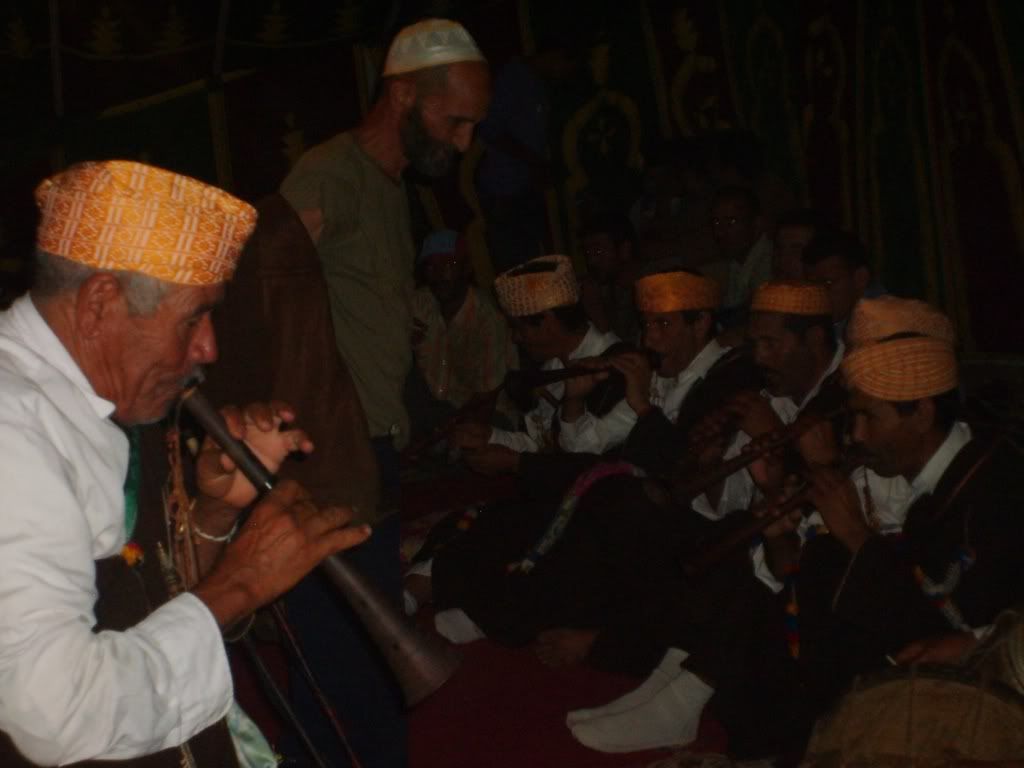
The Master Musicians of Joujouk photographed in 2005 by Frank Rynne
The Brian Jones recordings form part of the cultural heritage and inheritance of the village. The musicians living and dead who played on it mostly still have strong family connections in the village. I am often introduced to the sons and daughters of late great masters or former leaders of the Master Musicians who have returned to visit their families. The relatives of Mallim Fudal, Berdouz, Sherkin and of course Ahmed El Attar the current leader is son of Master piper Titi and is also the nephew of the late Hadj Abdelslam Attar, who was lead piper in the mid seventies and the father of Bachir Attar. El Hadj died twelve years before I got to Joujouka. The old generation were something…………strong uncompromising men with a great sense of humour. Berdouz loved sweets, I used to meet him in the village and he always wanted sweets. He had a demeanour like the Dalai Lama but less complicated. A beautiful soul. I have a painting Hamri did of Berdiouz in 1994 when I was there first. As the years went by, on each of my returns, I was greeted with the bad news of many musicians passing. Mohamed Mokchan is the oldest now at 76 years. The rest of the musicians are between the age of 45 and 65 but thankfully there are many young musicians too.
Who were the musicians on the albums you recorded and what did they play?
Ahmed El Attar drum and vocal
Mohamed El Attar lira and rhiata and vocals
Mustapha El Attar drum
Ahmed Bouhsini rhiata lira
Abdelslam Boukhzar drum vocal,
Abdelslam Errtoubi rhiata and lira
Mujehid Mujdoubi lira
Muinier Mujdoubi drum
Muckthar Jagdhal drum and vocal
Mohamed Mokhchan rhiata and lira
Abdelslam Dahnoun drum, rhiata, lira
Abdellah Ziyat Rhiata, lira, vocal
El Hadj clapping and vocal
Si Ahmed violin
There are more whose names escape me right this moment and of course Hamri sang on the song he wrote in honour of Brian Jones, "Brian Jones Joujouka Very Stoned" which is on the album Joujouka Black Eyes.
How do the Musicians teach and pass their skills on?
The music is part of life in the village so people learn the tunes very young. Playing the flute is a great way for a boy to pass the day when minding sheep. You can hear their attempts in the distance when in the higher mountains. Rhythm is for dancing to and at weddings and festivals the rhythm of Joujouka seeps into the consciousness of the young Joujouki from the feet up.
Not every Joujouki becomes a Master Musician though, what instruction do those who want to be one get?
Some are soldiers, shoemakers, shopkeepers and the rest. Hamri's brother is a weaver. If a musician wants to join the masters he gets his first instruction at home or develops natural ability. Later when the masters play together young musicians join them and get instruction from the collective group. It is a very organic and lifelong process. The skills needed to play the rhiata and do circular breathing are learned over years. Likewise the complex rhythms must be learned. The repertoire of the village forces the younger musicians to learn different skills when playing the different types of Sufi music and Boujeloud. Even the old musicians discuss aspects of each others performances. Each has his own recognisable signature.
Are you still recording in Joujouka?
I still record music but I have recently been filming again in the village. Last year I began work on a DVD project when Billy Corgan came down with me. Maki Kita, who is a talented Japanese visual artist, filmed their Porto show and I have several things being filmed right now in Morocco. The DVD will be on Sub Rosa's new film label and will show the real life of the musicians and their work in Morocco as well as abroad. The next recording project will be on a grander scale than my early field work but it will be recorded in the village.
You told me about a new guest house that should be ready for the Festival in Joujouka at the beginning of August. What stage is the building at?
The new guest house being built by The Master Musicians of Joujouka will be opened on 1 August as part of the four day Festival Sidi Ahmed Scheich de Zahjouka. It is a small traditional Joujouka house. It has a garden with olive trees. The musicians have long needed a new headquarters and a place to let guests stay. This is a great local initiative. Every year people show up randomly in the village often at dusk and the people have to scrabble around to try and put them up, children get moved around to free rooms up for the unexpected guests. The guest house will allow the musicians to put up visitors and take bookings from small groups for short breaks in the village.
Tell me more about the Festival.
The Festival Sidi Ahmed Scheich de Zahjouka is now in its sixth year. It hosts readings, discussions on culture and the arts, discussions on the local co-operative movements and helps bring attention to the folk arts like weaving, baking and of course The Master Musicians of Joujouka play each night. The local co-operative in Joujouka employs many women in traditional arts and is a great initiative for the area. Cash jobs for the women in the mountains are rare so this is important as it may help some women stay in the mountains rather than seek a livelihood in the nearby towns of Ksar El Kebir, Larache or Tangier.
The Festival and the guest house are both very important for the village to survive. How will the guest house be booked?
Anyone who wants to go should email joujouka@gmail.com and they will be forwarded to a local who speaks French and English. They will take their bookings, arrange to meet them and bring them to the village if necessary. Visitors will experience a unique Morocco with the Master Musicians of Joujouka in an ethical and sustainable way. All money will be paid directly to the musicians.
From a Europeans point of view, how much of the village of Joujouka is able to continue with its traditions and not bow to outside influences?
Much abides, but like everywhere in the world, the rush towards mobile phones, TV, and DVD is unavoidable. "Japanese shit" Hamri called it. However there are tribal traditions that survive all this. People from Joujouka have to have the Masters play at their weddings and festivals. August and September are very busy months for the Masters as many people return to the mountains to get married. The musicians hardly sleep all month.
And what of local crafts and diet?
The diet in Joujouka is generally home produced and the olive oil is second to none. In a world where people pay premium for organic, Joujouka is and always has been organic. The food tastes great. The people know about the quality of food. However the price of some local items is quite high. Very good mountain honey can cost $20 a litre in the village. It is used medicinally. Manufactured plastic goods are a big problem and threat to local crafts. The weaving of mats and rugs, blankets and traditional high quality wool has been affected by cheap Chinese plastic versions. I think that the Master Musicians of today are very firm in what they want to preserve in their culture but they know that the only way to keep young people active in the arts is for them to have a credible income from their work.

Boualem Hamri, brother of Hamri and friend of Brion Gysin weaving in Joujouka/Jajouka 2007. by Frank Rynne
And how far has the village embraced the 21st century?
In the last few years electricity has reached Joujouka. Therefore the people have light and some have TVs and DVDs. The mobile phone has also arrived; indeed Joujouka has a large mast. The musicians have all seen the internet and see their Myspace and website when they visit Ksar El Kebir. The young people learn French in school which is a big development there. The road has been paved and is no longer in danger of being washed away with every rain. This means Joujouka has a taxi service linking it with Ksar El Kebir. These are recent developments and it is unclear how much the change will be. I think it will influence the children more but they still grow up in those remote hills. That in itself has a balancing effect.
And there we bring the interview to an end. That was a fascinating and incredible story Frank, thank you for telling it..............There is much to deliberate and meditate on. This music, culture and spirituality, has incredible historical connections, resonance and power. I cannot overstate how much so.
To hear the albums Frank talks about buy them from their online shophere.
The Master Musicians have a website as well as a myspace page, where there is lots more information.
="">

 Produced by Frank Rynne