The below article on Joujouka first appeared in the Ira Cohen edited Gnaoua magazine published in Tangier in 1964. Ira also edited the Hashish Cookbook.
The magazine featured among others Brion Gysin, William Burroughs and Paul Bowles. Gysin's article was later incorporated by Brian Jones into the booklet that accompanied the 1971 release of the album he recorded and produced by the Master Musicians of Joujouka: "Brian Jones presents the Pipes of Pan at Joujouka", Rolling Stones Records, October 1971.
A controversial 1995 reissue CD featured a version of Brion Gysin's text from which Cherie Nutting edited out the second paragraph which references Gysin's discovering Joujouka/Jajouka through Mohamed Hamri. Brion died in 1986.
Hamri was the torch carrier for the true Sufi music of Joujouka/Jajouka . The type of manipulation of historical and current fact such as the posthumous editing of Brion Gysin's text is typical of Nutting's commercial drive on behalf of her then husband Bachir Attar. Nutting and Bachir's dishonest self proclamation that he is a "hereditary" leader of the Master Musicians forms the cornerstone of the pr to promote his saccharine World Music group "Master Musicians of Jajouka led by Bachir Attar" A.K.A. " Master Musicians of Jajouka featuring Bachir Attar". which Nutting still manages.
The magazine featured among others Brion Gysin, William Burroughs and Paul Bowles. Gysin's article was later incorporated by Brian Jones into the booklet that accompanied the 1971 release of the album he recorded and produced by the Master Musicians of Joujouka: "Brian Jones presents the Pipes of Pan at Joujouka", Rolling Stones Records, October 1971.
A controversial 1995 reissue CD featured a version of Brion Gysin's text from which Cherie Nutting edited out the second paragraph which references Gysin's discovering Joujouka/Jajouka through Mohamed Hamri. Brion died in 1986.
Hamri was the torch carrier for the true Sufi music of Joujouka/Jajouka . The type of manipulation of historical and current fact such as the posthumous editing of Brion Gysin's text is typical of Nutting's commercial drive on behalf of her then husband Bachir Attar. Nutting and Bachir's dishonest self proclamation that he is a "hereditary" leader of the Master Musicians forms the cornerstone of the pr to promote his saccharine World Music group "Master Musicians of Jajouka led by Bachir Attar" A.K.A. " Master Musicians of Jajouka featuring Bachir Attar". which Nutting still manages.
Sadly avarice has led them to campaign against the village and musicians of Joujouka/Jajouka and it continues to this day, depriving the masters and the village of their royalties from old releases and interfering with their ability to tour their Sufi trance music. The Master Musicians of Joujouka and their representatives have over the past two years sought a mediated solution to this problem as the path of the Sufi is a path of peace. These attempts at a peaceful and honest resolution have been rebuffed. However, the Master Musicians of Joujouka will continue to perform their pure Sufi trance music. Peace is the path of the righteous. (If you would like to help the Masters email joujouka@gmail.com)
Gysin's words are below restored to the full original text. You can download a pdf of the original Brian Jones sleeve and booklet from www.greylodge.org/occultreview/glor_015/media/Joujouka/joujouka_booklet.pdf
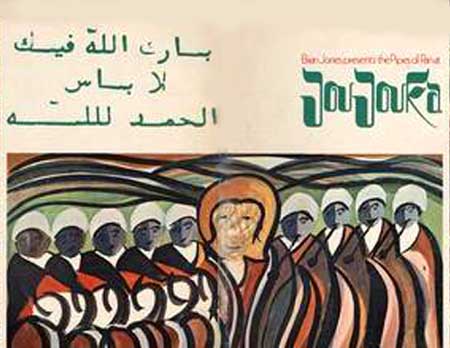
The painting of Brian Jones and the Master Musicians on the original LP is by Hamri who introduced Gysin and Burroughs to the Sufi trance masters and also brought Brian Jones to Joujouka on three occasions in 1967 and 1968.
See the 1992 Cherie Nutting photo of her husband which replaced the art by Hamri which Brian Jones commissioned for his LP.
Here
--------------------------------------------------------------------------------------------------------

Brion Gysin painting of Boujeloud, 1958
MAGIC calls itself The Other Method for controlling matter and knowing space. In Morocco, magic is practised more assiduously than hygiene though, indeed, ecstatic dancing to music of the brotherhoods may be called a form of psychic hygiene. You know your own music when you hear it one day.You fall into line and dance until you pay the piper.
My own music turned out to be the wild flutes of the hill tribe, Ahl Serif whom I met through the Moroccan painter, Hamri. He turned me on to the Moorish fleshpots, the Magic and the misery of the Moors. The secret of his mother's tribe, guarded even from themselves, was that they were still performing the Rites of Pan under their ragged cloak of Islam.
Westermark, in his book on pagan survivals in Morocco forty years ago, recognized their patron: Bou Jeloud, the Father of Skins, to be Pan the little goat god with his pipes. An account of their dances led him to conclude they must be celebrating the Roman Lupercalia which once occurred in the first two weeks of February, but attached itself to the principal Moslem feast when the Arab invaders turned the calendar back to the lunar year. Westermark never saw the dances and believed they no longer took place. Pan may soon stop dancing in the Moroccan hills but I first saw him there in 1950. Later I ran several times in the panic of the Lupercalia. It is the "holy chase" of which Julius Caesar speaks in Act 1, Scene 2 of Shakespeare's play: "Forget not, in your haste, Antonius, to touch Calpurnia; for our elders say the barren, touched in this holy chase, shake off their sterile curse." Marc Antony should be wearing a fresh, foul-smelling goatskin. "I saw Marc Antony offer him a crown; yet 'twas not a crown neither, 'twas one of those coronets. .."
Bou Jeloud wears a yokel's big, floppy straw hat, bound round his face with a fillet of ivy. ". . . it was mere foolery; I did not mark it." Elizabethan "Morris" dances were Moorish .
Pan, Bou Jeloud, the Father of Skins, dances through eight moonlit nights in his hill village, Joujouka, to the wailing of his hundred Master Musicians. Down in the towns, far away by the seaside, you can hear the wild whimper of his oboe-like raïtas; a faint breath of panic borne on the wind. Below the rough palisade of giant blue cactus surrounding the village on its hilltop, the music flows in streams to nourish and fructify the terraced fields below.
Inside the village the thatched houses crouch low in their gardens to hide the deep cactus-lined lanes. You come through their maze to the broad village green where the pipers are piping; fifty raïtas banked against a crumbling wall below sheet lightning to shatter the air. Fifty wild flutes blow up a storm in front of them, while a platoon of small boys in long belted white robes and brown wool turbans drums like young thunder. All the villagers, dressed in best white, swirl in great circles and coils around one wildman in skins.
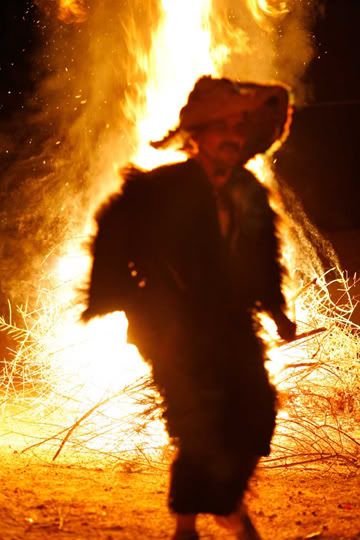
Bou Jeloud leaps high in the air on the music, races after the women again and again, lashing at them fiercely with his flails. "Forget not in your speed, Antonius, to touch Calpurnia . . ." He is wild. He is mad. Sowing panic. Lashing at anyone; striking real terror into the crowd. Women scatter like white marabout birds all aflutter and settle on a little hillock for safety, all huddled in one quivering lump. They throw back their heads to the moon and scream with throats open to the gullet, lolling their tongues around their empty heads like the clapper in a bell.
Every mouth is wide open, frozen into an O. Head back and hot narrow eyes brimming with dangerous baby. Bou Jeloud is after you. Running. Over-run, Laughter and someone is crying. Wild dogs at your heels. Swirling around in one ring-a-rosy, around and around and around. Go! Forever! Stop! Never! More and No More and No! More! Pipes crack in your head. Ears popped away at barrier sound and you deaf. Or dead! Swirling around in cold moonlight, surrounded by wild men or ghosts. Bou Jeloud is on you, butting you, beating you, taking you, leaving you. Gone! The great wind drops out of your head and you hear the heavenly music again. You feel sorry and loving and tender to that poor animal whimpering, grizzling, laughing and sobbing there beside you like somebody out of ether .Who is that? That is you.
Who is Bou Jeloud? Who is he? The shivering boy who was chosen to be stripped naked in a cave and sewn into the bloody warm skins and masked with an old straw hat tied over his face, HE is Bou Jeloud when he dances and runs. Not Ali, not Mohamed, then he is Bou Jeloud. He will be somewhat taboo in his village the rest of his life. When he dances alone, his musicians blow a sound like the earth sloughing its skin. He is the Father of Fear. He is, too, the Father of Flocks. The good shepherd works for him. When the goats, gently grazing, brusquely frisk and skitter away, he is counting his flock. When you shiver like someone just walked on your grave—that's him: that's Pan, the Father of Skins. Have you jumped out of your skin lately? I've got you under my skin.
Up there, in Joujouka. you sleep all day—if the flies let you. Breakfast is goat-cheese and honey on gold bread from the outdoor oven. Musicians loll about sipping mint tea, their kif pipes and flutes. They never work in their lives so they lie about easy. The last priests of Pan cop a tithe on the crops in the lush valley below. Blue kif smoke drops in veils from Joujouka at nightfall. The music picks up like a current turned on. The children are singing, "Ha, Bou Jeloud! Bou Jeloud the butcher met Aisha Homolka, Ha, Bou Jeloud!"
On the third night he meets Aisha Homolka who drifts around after dark, cool and casual, near springs and running water. She unveils her beautiful blue-glittering face and breasts and coos. And he who stammers out an answer is lost. He is lost unless he touches the blade of his knife or, better still, plucks it out and plunges it into the grcund between her goatish legs and forked hooves. Then Aisha Homolka, Aisha Kandisha, alias Asherat, Astarte, Diana in the Leaves Greene, Blest Virgin Miriam bar Levy, the White Goddess, in short, will be his. She must be a heavy Stone Age matriarch whose power he cuts off with his Iron Age knife-magic.
The music grooves into hysteria, fear and fornication. A ball of laughter and tears in the throat gristle. Tickle of panic between the legs. Gripe of slap-stick cuts loose in the bowels. The Three Hadji. Man with Monkey. More characters coming on stage. The Hadji joggle around under their crowns like Three Wise Kings. Monkey Man comes on hugely pregnant with a live boy in his baggy pants. Monkey Man goes into birth pangs and the Hadji deliver him of a naked boy with an umbilical halter around his neck. Man leads Monkey around, beating him and screwing him for hours to the music. Monkey jumps on Man's back and screws him to the music for hours. Pipers pipe higher into the air and panic screams off like the wind intothe woods of silverolive and black oak, on into the Rif mountains swimming up under the moonlight.
BRION GYSIN. Copyright 1964 Brion Gysin.
Special thanks to Ira Cohen http://www.magic.be/Akashic/Ira.html
Master Musicians of Joujouka links
Official website
Master Musicians of Joujouka on Myspace
Ethical Shopping to buy Buy CDs and books Click Here