Wednesday, July 1, 2009

Burrough's Naked Lunch 50th Anniversary in Paris First photos of Plaque unveiling at Beat Hotel 1 July 2009 .

Jean Jacques Lebel and Miles photo Frank Rynne

Eddie Woods read from Harold Norse's 9 Rue Git le Couer

Frank Rynne producer and manager of Master Musicians of Joujouka
photo Lars Movin


Lars Movin co director William Burroughs On the Road centre,
Eddie Wood's back and Philip Woods with shades photo Frank Rynne


Terry Wilson interviewed by Prof. Oliver Harris on Gysin and Burroughs
at the 50th Anniversary of the publication of Naked Lunch Symposium, 1 July, 2009.

Beat Hotel


Jean Jacques Lebel unveiling the plaque photo Frank Rynne


Burrough's Naked Lunch 50th Anniversary of publication in Paris.
Photos of Plaque unveiling at Beat Hotel Jean-Jacques Lebel and the proprietress of the Vieux Paris . all
photos by Frank Rynne except as stated.


Today marked the opening of the Paris leg of the 50th Anniversary of Naked Lunch in Paris. Events can be found HERE

Many friends of Brion Gysin, William Burroughs, Allen Ginsberg and the oeuvre de Burroughs met today at the Beat Hotel for the unveiling of a plaque commemorating the Beat Hotel. It was in the Beat Hotel that Brion Gysin, infused with eight years of Moroccan life, began to influence William Burroughs to adopt the Cut-Up Method of writing.

Gysin and Ian Somerville, to a backdrop of Gysin's own recordings of the Master Musicians of Joujouka, developed the Dreamachine at the Beat Hotel. Burroughs experimented with all kinds of Cut-Ups including tape cut ups with Ian Sommerville and Brion Gysin which, were the precursor of modern day sampling. Antony Balch took the Cut-Up to kineculture with his movies with Burroughs like Towers Open Fire and The Cut Ups.


Burroughs devised magical spells and the results of his experiments are well documented in Terry Wilson's Here to Go Planet R101 Revisited book with Brion Gysin.

Terry was guest speaker today at the symposium. He spoke of the dark world and the tragic individuals who were drawn like moths to the flame of the Burroughs/Gysin nexus. Wilson is the last true practitioner of the the black arts of fiction writing that Burroughs and Gysin delved into. His novels are a testimony to an enduring spirit of documentation and exorcism that is also evident in the novels of William Burroughs.


excerpt from Towers Open Fire by dir. Antony Balch

Monday, June 29, 2009

THE MASTER MUSICIANS OFJOUJOUKA MARK 40 YEARS SINCE BRIAN JONES CAME CALLING. Mojo Oct 2008


"You Should be trancin'" Mark Paytress reports on last year's Master Musicians of Joujouka, Brian Jones 40th Anniversary Festival in Joujouka which took place July 29-30, 2008.


You Should be trancin

by Mark Paytress Mojo, October, 2008.

THE MASTER MUSICIANS OF JOUJOUKA MARK 40 YEARS SINCE BRIAN JONES CAME CALLING ON THE GREAT GOD PAN.

BY MARK PAYTRESS

A tiny man wrapped In goat-skins brings his frenzied movements to an.. abrupt standstill in front of MOJO's reporter, undercover in fez and ankle-length djellaba for the night. He fixes my gaze like a man possessed, rolls his head rapidly from side to side, and starts whipping me with an olive branch. Have I really travelled 2,000 miles to endure this?

Yes, of course.This is all part of the ancient Rites of Pan, an annual ceremony that takes place in the foothills oft heRif Mountains in north Morocco, where the 500 or so villagers of Joujouka gather in a dusty square for a through-the-night Boujeloud ritual that will ensure the fertility of both crops and community.


Tonight, though, the event has special significance. Forty years earlier, on July 29,1968, Rolling Stones guitarist Brian Jones, together with Olympic Studios engineer George Chkiantz, rolled into the village with a 2-track Uher and recorded what writer William Burroughs called the "diabolic music" of The Master Musicians of Joujouka. Released in October 1971, two years after Jones's death, Brian Jones Presents The Pipes Of Pan At Joujouka remains a land- mark in what's now called world music. It also made Jones - famously unloved by his band at this point - a legend out here. "He looked strange with his big hair," recalls 94-year-old Abdeslam El Attar, who played on the album, but still the villagers cele-brate him in song: "Ah Brahim Jones/Joujouka very stoned".

Tonight, MOJO is among 40 or so awe-struck non- villagers following in the footsteps of the dandy prince of '60s pop. Some such as Michael Dean Odin Pollock from Iceland, are here thanks to Jones.

Others, like Mark English from Texas, come via the beat generation connection or, like Maeve Mooney from Sligo, Ireland, because they are simply "in love with the idea of the whole trance thing".

Also in attendance is Anita Pallenberg, Jones's girlfriend on his earlier visits to Morocco. Slim, chain-smoking and approachable (at least, when no one pokes a microphone at her), she spends much of her time capturing the amber, surprisingly verdant landscapes in her sketch- book. "Brian was pure," she says, when asked what had brought Jones to this remote, unforgiving corner of the globe. "He probably enjoyed the purity because he was so impure!" adds her companion, John Dunbar, one-time spouse of Marianne Faithful! Who remembers the golden Stone enthusing wildly about the tapes on his return to London in August 1968.


This unique event is the brainchild of Frank Rynne, one-time frontman for The Baby Snakes and a passionate advocate of the music of Joujouka, who's been coming to the village since 1994. He's produced three CDs for the Master Musicians and has plans to release this anniversary performance on CD and DVD. "The musicians have had a lot of problems keeping control of their own heritage," he says, a likely reference to Bachir Attar's breakaway group that performs a more Western- friendly version of the music. "This doesn't sit well with musicians who are used to that collective approach playing very pure folk music," he adds.


For four lazy days and exhilarating nights, MOJO gets a taste of life as part of that collective. In the village are 200 or so dwellings, including a mosque and a shrine to the local saint, Sidi Ahmed Scheich, alias The Healer Of Crazy Minds. Further up the mile-long dirt-track that leads to the village is the house of local son Hamri, 'The Picasso of Morocco', who brought writers Paul Bowles, Brion Gysin and William Burroughs here, as well as Jones. Hamri died in 2000, but the newly built guest house, where the Master Musicians treat us to long, spontaneous performances of their hypnotic healing music, looks down on his old residence in silent recognition of his work on behalf of the village. It is here that, sans footwear, we take refuge from the scorching heat, the cash hungry youths and the diamond-backed viper that we met while visiting Boujeloud's cave further up the hill. It's also where we eat: lamb shanks for the carnivores, whole fish, carrots and potatoes for those who decline the invitation to witness the 90-minute transformation of a sheep into a meal. Accompanied by giant wheels of Moroccan bread and incongruous bottles of Coke and Fanta, it's heavy fare, as your reporter discovers when invited to shake a little post-meal action. "Mesyen besef!"cry the Masters.


No one can compete with goat-man Boujeloud, though, whose manic, shiver'n'shake moves make Cocker, Curtis and Fay Fife seem positively sluggish in comparison. As the nine royally attired Masters hit their Rite stride, the shrill drones and darting melodies of their oboe-like rhaitas weaving a mesmerising spell over the pounding tebels, and a glowing bonfire lights up the shadowy, rock- strewn square, Boujeloud whips up the crowd. A two-foot kif pipe goes round. Boisterous boys in the shadows leap and yell uncontrollably as the hairy apparition chases them with his fertility stick. A giant toad emerges from under a rock. High only on the distinctly pagan-like vibe, your reporter soon feverishly succumbs to what Jones described as "the spirit and magic of Joujouka".


Had Jones returned here again in spring 1969, as he intended before being sacked by the Stones, the tragic course of his life might have been altered. However, while history can not be changed, the mysteries of this music from the Moroccan hills also endure. Back in London several days later, the sounds of Joujouka play on in my head. This Moroccan roll is strong stuff, indeed.

Anita Pallenberg and John Dunbar, Joujouka, July 28 2008. Photo Frank Rynne

Acting THE GOAT

THE 4,000-YEAR-OLD

ROCK'N'ROLL BAND

EXPLAINED

It was acid advocate Timothy Leary who first dubbed the Master Musicians Of Joujouka 'The Four Thousand YearOld Rock'n'Roll Band" in his Jail Notes memoir in 1971. He did so on the advice of William Burroughs (left!, who saw parallels between the Boujeloud rite and the ancient Greek god Pan, and concluded that the ritual music had a similar provenance. What is certain is that Joujouka's original Sufi musicians came to the mountains of Al-Sherif from Persia around the seventh century. One thousand years later, this sacred music was co-opted by the Royal Court of Morocco, whose Sultans saw it both as an aid to healing and as a rousing prelude to battle. The Legend Of Boujeloud, as chronicled by Hamri in his 1975 book of short stories. Tales of Joujouka, tells of the cave-dwelling goat-man who gifts villager Attar with a flute in exchange for the hand of a local woman. The annual ritual re- enacts Boujeloud's arrival, his encounter with Crazy Aysha, and his departure, that leaves the villagers transformed and spiritually regenerated. "It works!" insists Frank Rynne. "Anita was feeling a bit ill when she arrived, but after hearing the music, she's feeling great.


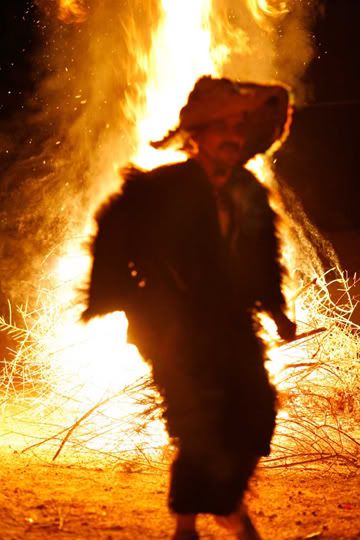
Boujeloud, July, 2008 copyright Jill Furmanovsky/Rock Archive

See PDF of article


Wednesday, June 17, 2009

Disclaimer re Meltdown Festival London: Master Musicians of Joujouka are not the group playing in South Bank

Disclaimer about the Meltdown Festival at Southbank Centre London

Many newspapers report that The Master Musicians of Joujouka are playing this week’s Meltdown Festival in London, the group is not in London this week. We were contacted some months ago by the South Bank Centre to avoid confusion our management suggested that they should check who Ornette Coleman as who had formed a social relationship with the then New York based Bachir Attar.
The group playing in London is the commercial World Music troupe that trades off the reputation and history of this group . It is the Bachir Attar led Jajouka troupe not the Sufi trance Master Musicians of Joujouka. The troupe playing in London does not represent the people and village of Joujouka/Jajouka or of the Master Musicians who live there.

Though from the village, Bachir Attar is not part of the Sufi brotherhood based in Joujouka/Jajouka. Other than Bachir Attar only one musician playing in London this week has ever played with Master Musicians of Joujouka/Jajouka. Neither are members of the brotherhood or village community.

Master Musicians of Joujouka such as Mallim Ali El Attar, age 100, is one of the musicians who actually played with Ornette Coleman in 1973. He was also playing at the recent Joujouka Festival June 5-7 in Joujouka, Morocco (see our blog on Myspace)

Any enquiries email joujouka@gmail.com

For recent article about The Master Musicians of Joujouka, See The Guardian 29 May 2009 Take me into insanity

Mallim Ali Abdelsalm Attar. Photo by Jill Furmanovsky
Mallim Ali Abdelsalm Attar, Aged 100, the oldest surviving Joujouka musician who recorded with Rolling Stones’ Brian Jones in 1968 and Ornette Coleman in 1973. Photographed by Jill Furmanovsky at the Brian Jones 40th Anniversary Festival in Joujouka/Jajouka, Morocco 29 July, 2008.

Saturday, May 30, 2009

Guardian Arcticle on Brian Jones 40th and 2009 Festival by Mark Paytress / Images by Jill Furmanovsky print editions 29th May 2009


Take me into insanity

In the Moroccan mountains, village musicians gather each year to worship the goat-man Boujeloud ... and Brian Jones. Mark Paytress joins in the wild party


Photobucket

Joujouka Brian Jones Festival 2008 Joiner Image by Jill Furmanovsky/Rock Archives

Joujouka, a village nestled in the foothills of the Rif mountains in northern Morocco, has been attracting enlightenment-chasing subversives and sonic novelty-seekers for decades. They are drawn by its Sufi trance music, played by the Master Musicians of Joujouka on a pipe called the rhaita and a drum called the tebel. In the 50s, Paul Bowles and William Burroughs visited, and the latter concluded: "We need more diabolic music everywhere." Timothy Leary proclaimed the Master Musicians to be "a 4,000-year-old rock'n'roll band". And in July 1968, Brian Jones of the Rolling Stones dropped in to record the village's Boujeloud - or Rites of Pan - festival.

That gruellingly intense annual night of music, magic and fertility still takes place every year, though the village has changed since Jones's visit: it now has electricity and a mobile phone mast that dwarfs the minaret of the mosque. Much, however, remains medieval: there is no running water, and the climate and landscape still dictate how life is lived.

When Jones's recordings were released posthumously in 1971, as The Pipes of Pan at Joujouka, the village gained a new level of fame - the guitarist was followed by more musicians, including Ornette Coleman - and Jones himself gained a new status in the village as a near-saint. Last July, I was among 40 or so westerners who went to Joujouka to mark the 40th anniversary of his visit. I often heard the Master Musicians chanting "Ah, Brahim Jones, really stones" as they worked through a rhythm.

The idea to commemorate Jones's trip came from Frank Rynne, a frequent visitor to Joujouka since he stumbled on its music at a Burroughs-related event in Dublin in 1992. "Brian Jones is so revered here that I felt the anniversary of his visit should be marked," Rynne says.

However, the festival long predates Jones. Its origins lie in the legend of the goat-man Boujeloud bestowing the gift of music on the village in return for the hand of one of its women. Every year, the festival pays homage to Boujeloud in order to guarantee the village healthy crops and purposeful procreation. Much has been made of the magic and transcendence associated with this ancient fertility rite, but its real purpose is to heal. "Yes, the music makes people go into a trance," Master Musician Mohamed el Attar tells me, "but it also heals souls. Psychopaths get better when they hear it. That is the secret of this place."

As the ceremony begins, I follow the nine magnificently attired Masters - resplendent in yellow hats, white collarless shirts and dark, one-shoulder robes - as they make their way down a long, dusty track to a gently lit corner of the village square, where some 120 villagers and visitors are gathered. Without realising it, I perch upon the same rock Jones sat on 40 years ago, as the Masters hit their transcendent stride.

A group of watching youths, some dressed in baseball caps and logo-emblazoned T-shirts, bounce boisterously in front of the bonfire. Women huddle in the shadows. When the rhaitas, sounding something like a herd of aroused elephants, nudge up a semitone, the tingle factor really kicks in. A trick long favoured by a generation of superstar DJs is, it seems, as old as time itself.

Then out hops the sprite-like Boujeloud. Hours ago, he was the soberly attired master of the house where I slept. Now, this apparition in a straw hat and goat-skin is mad-eyed and rubber-necked; he thrashes me with a pair of olive branches. My fertility apparently secured, at least for another year, I leap to my feet and join in this primal scream of a party. For five long hours, these rhythms and rituals play out against a backdrop of spitting bonfires, screams and the endless high-jinks of Boujeloud. At about five in the morning, it winds down. "Boujeloud" is back in his bum-freezer jacket and handing out cups of mint tea to the small handful of us who have survived this exhilarating, extraordinary but exhausting musical endurance test.

When Brian Jones returned to London in August 1968, he spent hours in the studio doctoring his tapes with psychedelic effects (mainly phasing), in an attempt to accentuate the far-outness of an experience he likened to "an incantation to those of another plane". Many later sonic adventurers, working in jazz or rock or experimental music, have drawn inspiration from the music of Joujouka. Even the Stones milked what Mick Jagger admitted was "a tenuous musical connection" by using the Master Musicians on their 1989 Steel Wheels album.

Since that time, artists from the village have travelled to the west - drawn as much by the financial as the spiritual rewards - to perform music from Joujouka and the surrounding region. As we drive off at dawn the following morning, the first of the day's five calls to prayer ringing in our ears, I wonder whether I have just witnessed a long, loud, final blast of a tradition that's now staring extinction in the face. But Rynne is more optimistic. He says the event has brought enough money and supplies to the village to keep the place thriving until the winter - and that's before the cash from a planned CD/DVD release rolls in.

"You saw the young men last night," he smiles, referring to the mass outbreak of Boujeloud-inspired mayhem. "It's impossible to my mind that those boys, growing up in the houses of musicians, won't one day be picking up drums themselves."

Maybe so. But whether they'll stay put in Joujouka rather than try their luck on the international stage is, of course, another matter.

• The 2009 Master Musicians of Joujouka festival runs from 5-7 June. Details: joujouka.net

Saturday, April 4, 2009

Master Musicians of Joujouka jajouka Ireland 1980 film


This footage was shot by Bob Quinn for his Atlantean documentary series.
Quinn broke new ground in his exploration of the connections between North African and Islamic culture and the Celtic musical and artistic traditions and folkloric traditions.
Here we see the Master Musicians of Joujouka /jajouka performing in Castlebar Co. Mayo in the remote west of Ireland.
In 1994 Frank Rynne producer of The Master Musicians of Joujouka talked to the then 82 year Mujehid Mujdoubie in Joujouka.

--------------------------

"After a few meetings Mujehid asks where I am from. Mohamed Attar, known as Ansari, had been to Dublin for The Here to Go Show and said Dub..Linn. I said Ireland. Mujehid started laughing.
"I've been to Ireland with Rickki (Stein)."

Hamri asks some questions. After Mujehid has talked a while Hamri asks me "
What's this swimming pool full of milk Mujehid says he saw in Ireland."
I am baffled but then I discover this pool was on a big farm and made of aluminium. "
That's just the storage cooler for the milk that all big farms would have, to keep it cool before it's collected."

Mujehid says, "no, it was too much milk for that, millions of litros."

" But that's how much milk a few hundred cows would give a day. Ireland is a big dairy producer."
" The cows here in Joujouka, if you were lucky would give you half a cup a day at this time of the year, this is why he can't believe you. " said hamri
The milk is soon forgotten as Mujehid has remembered a big deficiency he had noted in the Irish. It turned out that one day the Masters Musicians of Joujouka went to a big estate somewhere in the west of the country to help heal a young girl with their music. The musicians duly played the Rites Of Boujeloud and the healing music of Sidi Achmed Sheich and an improvement was noticed in the girl. The next day the girl's father took Mujehid to the town and bought him a goat for the musicians to kill and eat. Mujehid set off alone towards the big house holding the goat. He was not given to carrying goats in his arms. In Joujouka you simply walk behind them and they generally behave. Where would they go to ? He set the goat down. This Irish goat, full of the spirit of rebellion, took off down the road like a bullet. Mujehid chased it back into town. He eventually lost sight of the musician's dinner. He came up to some of the natives but soon discovered that not one of them had a word of Magrebi, not a single word. Mujehid tried to mime what had happened making horns on his head with his fingers, but no one could work out what he wanted and he never got his goat back. Years later in Joujouka he wants to know one thing, How come those Irish people couldn't speak Magrebi? http://www.thehandstand.org/archive/j...
Master Musicians of Joujouka Festival 2009, Joujouka, Jajouka, Morocco. June 5-7 2009 Booking Now on
http://www.joujouka.net

Thursday, March 12, 2009

A Rolling Stone’s Moroccan odyssey

Joujouka during the Brian jones Festival photo by Marc English

This article was published last year prior to the Brian Jones 40th Anniversary Festival in Joujouka. There are two segments of music and some great images from the festival on the Master Musicians of Joujouka Myspace Photos. See blogs for more info.

This year's festival takes place on the weekend of 5-7 June in Joujouka and guest will saty in the beautiful mountains of the Ahl Srif in the houses of the musicians and their families. This is an oppurtunity to come to Joujouka and see hear the World famous home under open stars. Enjoy the food of the mountains and rejoice in the The Master Musicians of Joujouka celebration of life through music with the people of Joujouka.
Booking Master Musician of Joujouka website


Click on newspaper to read original article.

A Rolling Stone’s Moroccan odyssey

The Irish Times
22 Jul 2008

WHEN I FIRST visited Morocco in 1994, I took a one-way charter flight to Malaga and a ferry across the Straits of Gibraltar. On one side of the Straits were the burnt hills of Southern Spain, on the other the high colossus of the Rif Mountains. Soon I...read more...
Tuesday, July 22, 2008
A Rolling Stone's Moroccan odyssey
In this section »


The group's founder member Brian Jones's obsession with the haunting music of Joujouka is to be recalled at a Moroccan festival in his honour, writes Frank Rynne .

WHEN I FIRST visited Morocco in 1994, I took a one-way charter flight to Malaga and a ferry across the Straits of Gibraltar. On one side of the Straits were the burnt hills of Southern Spain, on the other the high colossus of the Rif Mountains.

Soon I was standing in the ship's restaurant being inspected by curious frontier police in line with Djellaba clad men, women in fine silk robes and the odd backpacker. Having had my passport stamped in Arabic script, I could stay up to three months. Arriving at Tangier port, I was assailed by offers of taxi rides, protection, and beggars. The contrast with the sedate south of Spain could not have been greater.

I made my way to the Café de Paris to meet Hamri. Hamri had famously brought Beat writers Paul Bowles, William Burroughs and the painter Brion Gysin to his village in the 1950s. In the 1960s, he had taken Rolling Stones founder Brian Jones and LSD guru Timothy Leary. By 1973, Ornette Coleman, the inventor of "free jazz", had made the same pilgrimage to visit the Master Musicians of Joujouka. The musicians were described by Burroughs and Leary as a "4,000-year-old rock'n'roll band". According to Gysin, the musicians held a secret, hidden even from themselves: they still practised "the Rites of Pan under the ragged cloak of Islam". The "ragged" referring to the musicians' poverty.

The Master Musicians of Joujouka are Sufi trance musicians from a tiny village in the Southern Rif Mountains. They play a form of trance music which is used for healing. Each year in the village, a boy is sewn into goat skins to dance as Boujeloud, who appears to Westerners as Pan. The flute-playing goat god is the protector of shepherd boys who brings fertility in springtime. The musicians play ancient music to drive Boujeloud back to his cave. With the beast appeased by their music, they can expect a good harvest. Women touched by his flailing palm fronds will bear healthy children.

Hamri took me to his studio, where beautiful paintings hung in various stages of completion. Soon the smell of linseed oil and canvas was penetrated by cumin, coriander and chicken as Hamri prepared his famous harira soup.

The next morning, we took a series of taxis to Joujouka, making the last leg of the journey on foot, up a steep impassable track. We were laden with meat, tea, sugar, mint and other basic provisions for the musicians, the mosque and the sanctuary of the village's patron saint. Since the 9th century, Sidi Ahmed Schiech's sanctuary in Joujouka has been a place of pilgrimage for the Ahl Srif tribe.

I first met the Master Musicians in 1992. I helped bring them to Dublin to participate in the Here to Go show at the old Project Arts Centre. The show, in honour of Gysin, was the first joint exhibition of his and Burroughs' paintings. Gysin had invented the Cut-Up method of writing which Burroughs famously used to deconstruct the modern novel. Burroughs said of Gysin: "He was the only man I ever respected." He died in 1986 having never achieved the recognition that Burroughs felt he deserved. Hamri and Gysin had exhibited together in the early 1950s. Having heard the Master Musicians of Joujouka, Gysin abandoned the Western art scene and spent 23 years in Morocco to be close to them and their music. It was Hamri who suggested that an art show for Brion would be incomplete without Joujouka music.

At Hamri's house in the village, the musicians began to arrive singly and in small groups. I was overwhelmed by the welcome I received from the musicians who had been to Dublin. Soon a large group of cloaked men were sitting on the veranda. Tea was brewing and a tagine of lamb was slowly bubbling. Bamboo flutes, drums and sepsi pipes for smoking kif, a mix of mild marijuana and home grown tobacco, were produced.

The music began with long plaintive notes segueing into repetitive refrains and hypnotic drumming. This music is haunting and unworldly. They played the tunes left by their patron saint, which the musicians and their ancestors have played for centuries to heal illness and mental disturbances. They continued for several hours until dinner was served on a large plate from which we all ate communally.

After the meal, the musicians produced long mahogany double reed horns called rhiatas, which are similar to oboes. Their massed sound carries for miles in the little hills of the Ahl Srif.

The musicians use long extended notes and utilise circular breathing techniques. The horn players divide into sections and play extended loops following a lead section. They are loud as any rock band.

IT WAS MY LOVE of the Rolling Stones and, in particular, the enigmatic talents of their founder Brian Jones, that first made me aware of Joujouka. In 1982, I saw the Stones in all their stadia glory at Slane Castle. The subtle elegance of Jones' 1960s experiments with Eastern rhythm and instrumentation had been replaced by the hard edged, over-sexed blues rock that conquered the American mid-West.

Last week, I asked Anita Pallenberg what had set Brian Jones apart. "He was a renaissance man and a blues man, way ahead of his time," she said. Anita had famously been Brian's girlfriend when he entered a spiritual decline. Since his untimely death in 1969, the rock world has become all too familiar with such sensitive souls being crushed by the demands of an over-commercial oeuvre.

On July 29th, 1968, Gysin and Hamri brought Jones and his engineer George Chkiantz to Joujouka to record the Masters. For Jones, the experience was to dominate the last year of his life. His obsession with the music of Joujouka was yet another factor that distanced him from Jagger and Richards. Jones wished to incorporate it into the Stones's sound.

John Dunbar was a friend of the Stones's first manager Andrew Loog Oldham as well as Burroughs, Gysin and Jones. He remembers Brian on his return from Morocco coming to his flat to play the tapes. According to Dunbar: "Brian loved Joujouka and he hawked those tapes around trying to do something for the musicians. This really was going in a different direction from Mick and Keith."

Brian spent the rest of the summer preparing the art work and sleeve design for the LP. In the studio he experimented, playing the music out of synch. Jagger recently said that Brian's Joujouka experiments were the equivalent to scratching in the early days of hip hop.

In Morocco, Hamri, Gysin and the Master Musicians anxiously awaited the result of the star's labours. The musicians had received some money and they hoped that Brian's interest would rescue them from poverty by making their music popular in the West.

Hamri and Gysin had spent the 1950s and 1960s keeping the village going by employing troupes of musicians to play at their 1001 Nights restaurant in Tangier. Later, Hamri opened a second 1001 Nights in Asilah. It was in the latter that Jones first came to know the music and the musicians. Hamri would tell stories from his village to a reclining Jones. When Hamri would assume that Brian was asleep and stop his story, Brian would say in an English accent which Hamri imitated in recollection: "And then?" And the stories continued.

When the Rolling Stones set up their own record label in 1971, the first release was Brian Jones presents the Pipes of Pan at Joujouka . The cover painted by Hamri features Brian in the centre of the Masters. Some friends felt it was the least they could have done for Brian.

Over the last decade-and-a-half, I have visited Joujouka nearly 50 times, recording three CDs. Nearly all the older musicians who played on the Brian Jones record are now dead. Ahmed Attar, who at 12 years of age drummed on Pipes of Pan , leads the group in the village.

An old musician, Mujehid Mujdoubi, once asked me: "Why do you Irish people have swimming pools filled with milk, when the cows in Joujouka give barely one cup a day?" Having been to Ireland in 1980 as part of the group that appear in Bob Quinn's Atlantean documentary, he was referring to a modern dairy farm so different from Joujouka's medieval agriculture.

IN 2006, BILLY Corgan of Smashing Pumpkins contacted me and came to the village. I was on my way there anyway to bring the group to Casa Da Musica in Porto. After a week, he felt the music was the loudest and most intense acoustic music imaginable.

The lure of stardom led one musician, Bachir Attar, who emigrated to New York, to claim he was the hereditary leader of the musicians. Although he was a toddler in 1968, this claim was readily accepted by music business executives, leading to Brian Jones' LP being reissued in 1995 but bringing no benefit to the village. Hamri's original cover art was replaced with by a contemporary photograph of Bachir. All mention of Hamri was excised from Brion Gysin's original sleeve notes. Bachir trades under the eponymous "Master Musicians of Jajouka featuring Bachir Attar". In contrast to the musicians in Joujouka, he states he likes to work in the studio.

On July 29th, the Master Musicians of Joujouka host the Brian Jones 40th Anniversary Festival in the village square. Fifty Westerners will join the villagers for the festival of Boujeloud, celebrated to highlight Jones' contribution to the village and promote peace. Last year, the musicians built a two-room guest house for visitors. The legacy of Jones still affects the music and musicians.

A standard song now in the village repertoire is Brian Jones Joujouka Very Stoned . The lyrics go: "Joujouka mezyana b sseyyed dyala (Joujouka is good because the Sanctuary is powerful)./ Oh Brian Jones Joujouka very stoned, Oh Brian Jones Joujouka Rolling Stone."

• Master Musicians of Joujouka present the Brian Jones 40th Anniversary Festival in Joujouka, Morocco.

www.joujouka.net

• Frank Rynne has produced three CDs of Master Musicians of Joujouka, Joujouka Black Eyes (1995), Sufi: Moroccan Trance (1996) and Boujeloud (2006). He is an historian currently researching the Fenians and the Land War 1879-1882.
Original ad for Brian Jones presents the Pipes of Pan at Joujouka released on Rolling Stones Records in 1971.

Sunday, March 1, 2009

Master Musicians of Joujouka Festival 5-7 June 2009 Joujouka, Morocco

Master Musicians of Joujouka Festival 5-7 June 2009 Joujouka.
Booking Master Musicians of Joujouka website
The Master Musicians announce their summer festival will be held 5-7 June 2009 in their village in Morocco. Guests will stay with the musicians and their families and experience three days and nights of ritual Sufi music in its natural setting. On Saturday 6 June the musicians will perform the Boujeloud ritual in the village square through the night. In July 2008 the Master Musicians of Joujouka hosted the Brian Jones 40th Anniversary Festival in their village in the southern Rif Mountains of Northern Morocco. The festival was a celebration of fortieth anniversary of Brian Jones’ recording the iconic LP Brian Jones presents the Pipes of Pan at Joujouka (Rolling Stones Records 1971). The festival brought the families of old Masters now passed on and a group of visitors from abroad including old friends of the errant Rolling Stone.

Guests will experience life in Joujouka staying with the musicians and their families in their isolated village. The Master Musicians of Joujouka willplay in intimate sessions around their madrassa/school. The highlight of the festival wwill be the village’s celebration of the Boujeloud ritual in the village square.

Places at the festival are strictly limited as due to accommodation limitations with the families in Joujouka/Jajouka. Guests will be collected from Ksar El Kebir the nearest town to Joujouka on Friday 5th June and will be brought to the village. Full board will be provided. Food will be prepared in traditional Joujouka fashion from locally sourced produced. Joujouka is a framing community well as Sufi trance music the village is famous for its beautiful olives and olive oil.
The festival is booking now. The early
bird price is €250 euro.
Accommodation for 5, 6, and 7 June

Full board lunch and evening meal on Friday 5 June
Breakfast, Lunch and traditional Moroccan mountain feast on Saturday 6
Breakfast, Lunch, and evening meal Sunday 7th

Booking now on
Master Musicians of Joujouka Web Site
For payment by credit transfer please email me for details.
Places are limited to 75.

If you have any questions please do get in touch. joujouka@gmail.com

The Master Musicians of Joujouka being interviewed fro Mojo magazine July 30 2008.
The oldest musicians from Joujouka /Jajouka mallim Ali Abdelsalm El Attar talks to Mark Patytress. (photo Marc English)


Photobucket

Boujeloud, July, 2008 copyright Jill Furmanovsky/Rock Archive


"You Should be Trancin'" Mojo Oct 08 Report on Brian Jones 40th Anniversary Festival in Joujouka Words Mark Paytress new photos by Jill Furmanovsky PDF link to "You Should be Trancin'" Mojo Oct 08


Article by Frank Rynne on Brian Jones 40th Anniversary Festival , Irish Times, 22 July, 2008

Plus
BBC World Service The Beat
Frank Rynne chats with Anita Pallenberg on Brian Jones, Mark Paytress on visiting Joujouka, Ahmed Attar leader of the Master Musicians of Joujouka on the spiritual music of the village and Mallim Ali Abdelslam El Attar who at 94 is the oldest musician in Joujouka talks about Brian Jones and the old Mallims who recorded Brian Jones presents the Pipes of Pan at Joujouka.>All recorded at the Brian Jones 40th Anniversary Festival in Joujouka. "Forty years ago, guitarist Brian Jones, one of the founders of the British rock band the Rolling Stones, travelled to northern Morocco to record a group known as the Master Musicians of Joujouka. The resulting album, 'Brian Jones Presents the Pipes of Pan at Joujouka', not only had a lasting effect on the musicians themselves but went on to become hugely influential after being released on the Rolling Stones
own record label. We hear from Frank Rynne, a record producer and historian who recently visited Joujouka to record the Brian Jones 40th Anniversary Festival."BBC World Service Report From The Beat

To download or play Clip Click Here


Tuesday, February 10, 2009

Master Musicians of Joujouka Festival 5-7 June 2009 Joujouka, Morocco

This years festuival runs from 5-7 June 2009. Booking now on www.joujouka.net


Photobucket
Photo Jill Furmanovsky/ RockArchive

Book Now places limited for 5, 6 & 7 June 2009.

Music, photos, and slide shows from the Brian Jones 40th Anniversary Festival in Joujouka 28- 30 July 2008 on
Master Musicians of Joujouka Myspace

Master Musicians of Joujouka website and Booking
Photobucket
Joiner image by Jill Furmanovsky/ RockArchive